





Pichwai Art Print – The Return to Ayodhya by Lamplight
Free worldwide shipping | US customers no surprise tariffs
 Enquire About This Piece
 Instagram
 Email
Email
Arrives Exactly as Expected
Quality Control
Every painting is carefully inspected by our team before dispatch.
If requested, we'll also send you a photo for approval before shipping.
Secure Shipping
Each piece is shipped in a rigid protective tube to reach you safely.
Our team personally inspects each piece before dispatch.
Customer Service
Our London team is on hand to assist with any queries or issues.
We resolve concerns directly to ensure your satisfaction.
Shipping Policy
Free worldwide shipping | Exempt from US tariffs
Delivered in a protective hard-case tube with full insurance to ensure it arrives safely and undamaged.
Our prints are created using layered hand application, traditional pigments and natural binders. Drying and curing times vary depending on humidity, temperature and seasonal conditions.
Read our full delivery and fulfilment policy.
Etymology
Provenance
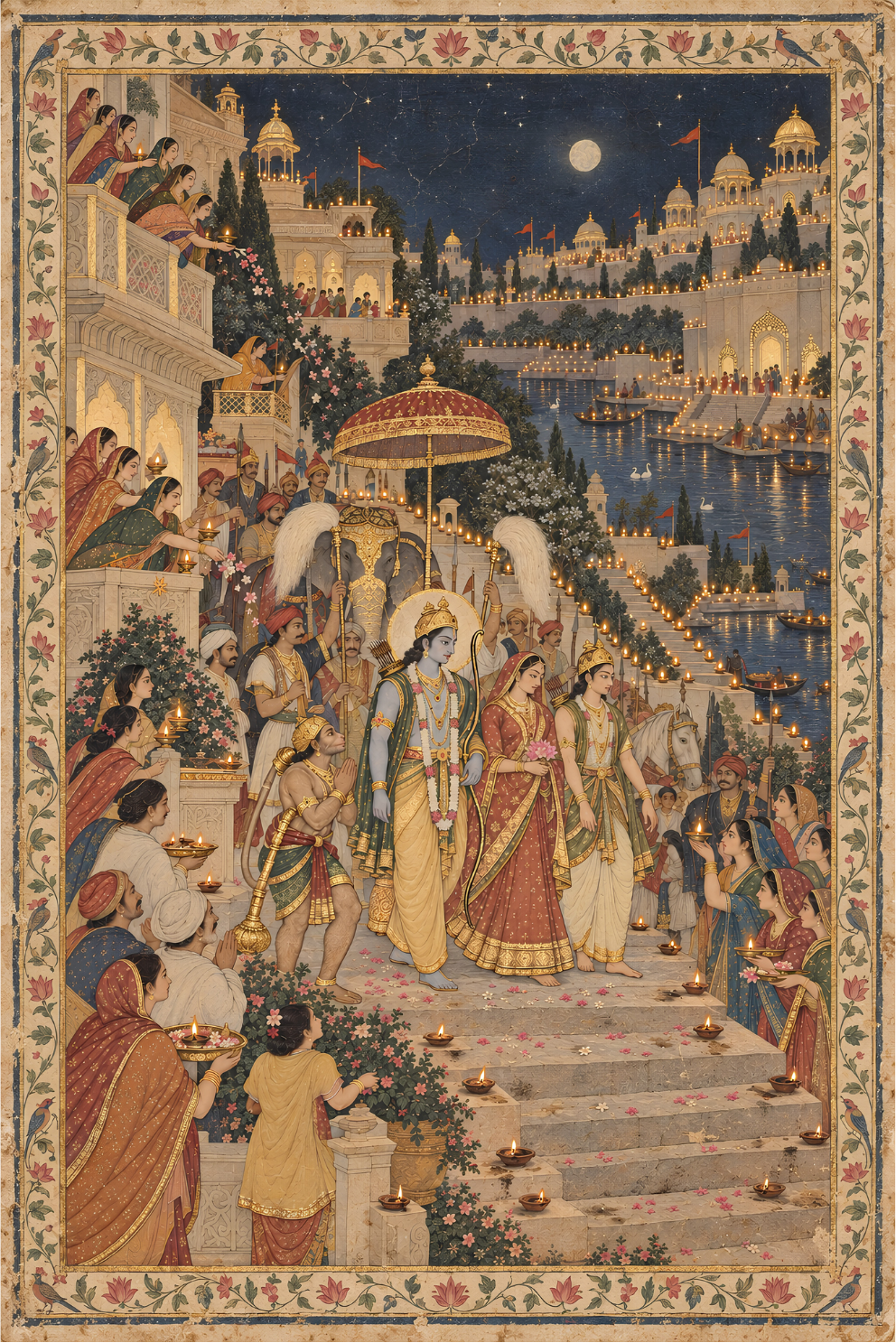
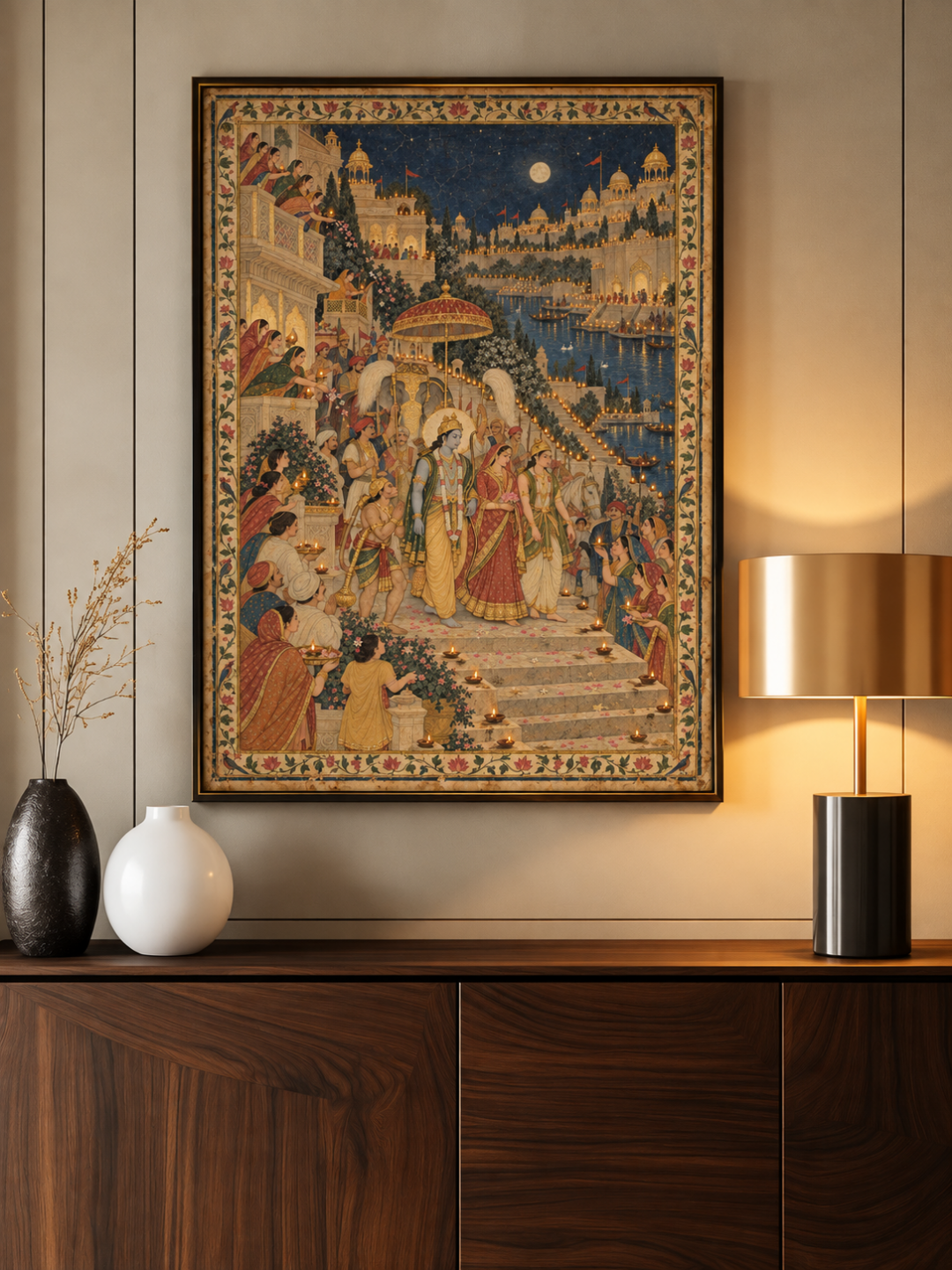
This Pichwai-style art print depicts the return of 'Rama' to Ayodhya, the episode from the 'Ramayana' that in many parts of India is remembered at Diwali, when the city is said to have lit rows of lamps to welcome him home after fourteen years of exile and the defeat of 'Ravana'. In the manner of 'Pichwai' painting, the scene is densely peopled and richly ornamented, seen from a high viewpoint, with architecture stacked into the distance and a floral border enclosing the whole, so that the homecoming unfolds as a night-time procession through a city alive with small flames.
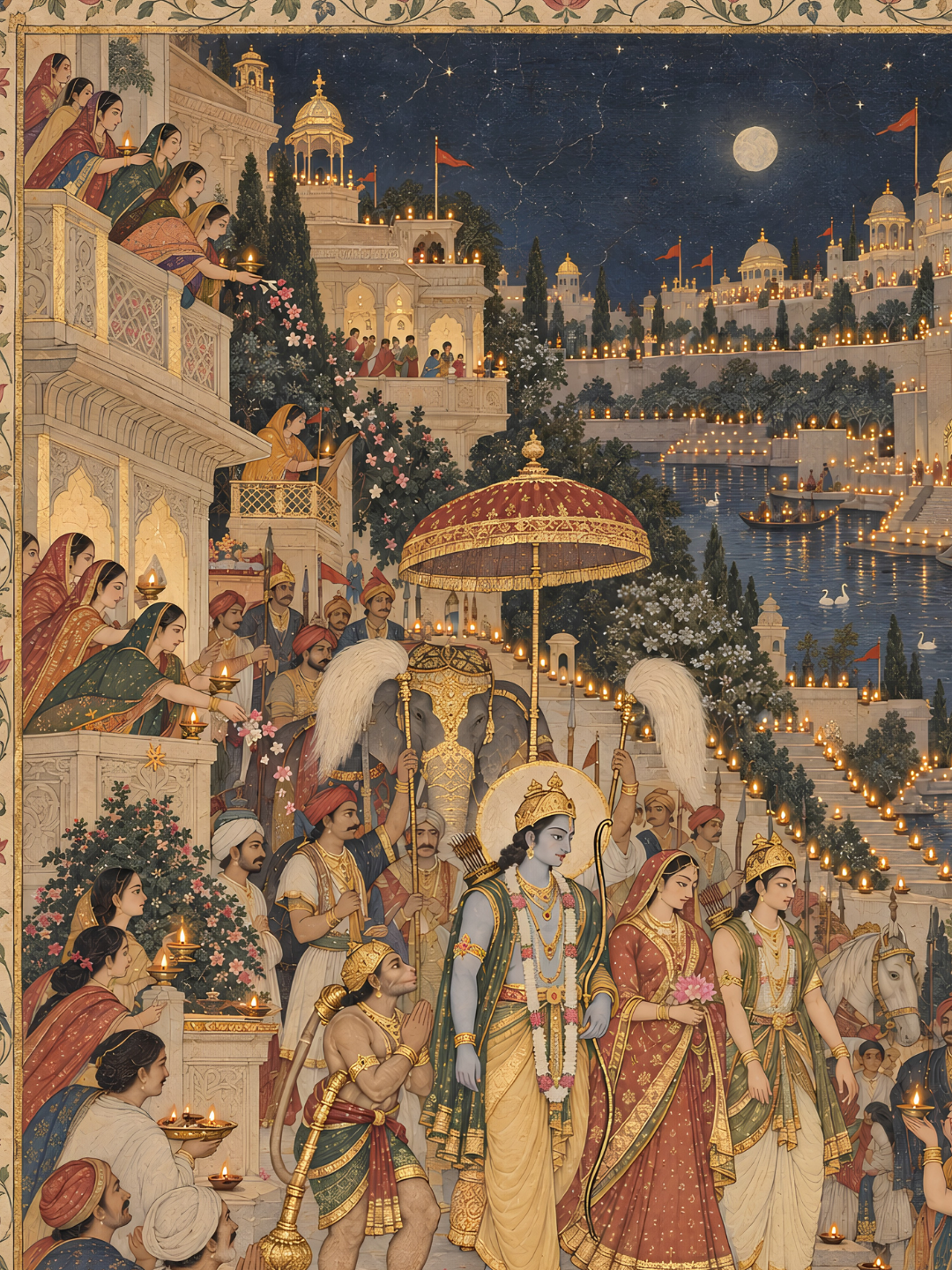
At the centre, 'Rama' walks down a broad flight of stone steps, blue-skinned, crowned and haloed, a bow at his shoulder and a quiver of arrows at his back, garlanded with white and red flowers. Beside him 'Sita', in a red sari worked with gold, holds pink blossoms, and to her right walks 'Lakshmana', also crowned and carrying a bow. 'Hanuman' kneels at the left with his palms joined in greeting, his mace resting against his shoulder. Above the group a red and gold parasol, a traditional emblem of royalty, is held aloft between two white fly-whisks, with a richly caparisoned elephant behind and a white horse at the right. Townspeople crowd the balconies and steps: women lean out to scatter petals and hold out lamps, others carry trays of lit diyas, and a small child in yellow looks up at the procession. Petals and flickering lamps line the steps and continue along every terrace and ghat down to a river where boats and swans drift past, while a white palace of domed pavilions and saffron pennants rises beneath a full moon. The lamps, the petals and the upturned faces all point towards the central figures, turning the whole city into a single gesture of welcome.
The palette sets a deep indigo sky and river against warm ivory stone, with reds, saffron and gold distributed through the crowd so that the eye travels steadily across the composition, and hundreds of tiny flames bring light into the night. The surface imitates an aged manuscript page, with creases, mottling and softened edges, and the ivory border is patterned with trailing vines, red flowers and small birds. These signs of age are part of the image's design and do not indicate a historical original; the Brahm piece is a made-to-order print that reproduces this archival appearance.
Disclaimer:
- The frames shown are for display purposes only and are not included with the artwork.
- As these are made-to-order designer pieces, expect minor colour variations from the displayed artwork.
Arrives Exactly as Expected
Quality Control
Every print is carefully inspected by our team before dispatch.
If requested, we’ll also send you a photo for approval before shipping.
Secure Shipping
Each piece is shipped in a rigid protective tube to reach you safely.
Our team personally inspects each piece before dispatch.
Customer Service
Our London team is on hand to assist with any queries or issues.
We resolve concerns directly to ensure your satisfaction.
Choose options