






The Wild Within: Why Animal Wallpaper is More Than Decoration
In India, animals are not visual accessories. They are embedded in how the world is understood, narrated, and ordered. They appear in mythology, ritual, architecture, and everyday language, not as embellishment, but as carriers of meaning. Elephants, tigers, peacocks, horses, and deer are woven into how strength, restraint, vigilance, grace, and continuity are imagined. When animal wallpaper appears in an Indian context, it inherits this history. It does not arrive as decoration. It arrives as reference.
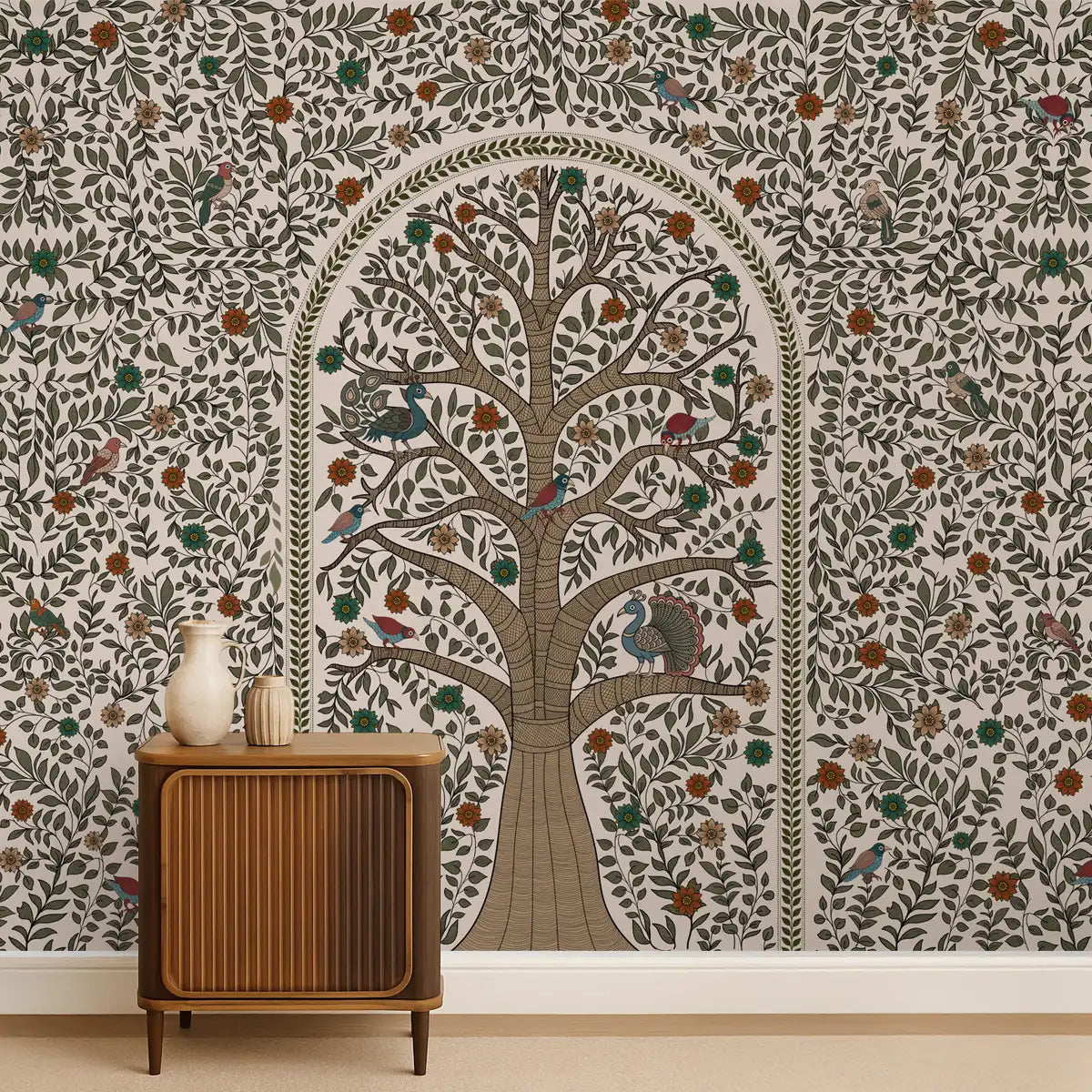
BRAHM’s animal wallpaper collection is built on this premise. These designs do not attempt to dramatise nature or romanticise wildlife. Instead, they treat animals as symbols shaped by centuries of visual culture. Each figure is positioned deliberately, not to dominate a space, but to anchor it within a longer tradition of seeing.
Animals as Structure, Not Motif
Long before wallpaper existed, Indian walls already carried animals. The cave paintings at Bhimbetka show deer, bison, and boar rendered in motion, their bodies reduced to essential lines and gestures. These images were not illustrative records of the natural world. They were part of how early communities understood movement, survival, and coexistence.
That approach did not disappear with time. As religious architecture developed, animals remained central. Temple reliefs, murals, and manuscripts continued to place animals alongside deities and humans, reinforcing a worldview in which life forms were interdependent rather than hierarchical.
This is the foundation of animal wallpaper in the Indian tradition. Animals are not added for visual interest. They are structural to the meaning of the surface.
Symbolism Refined Over Time
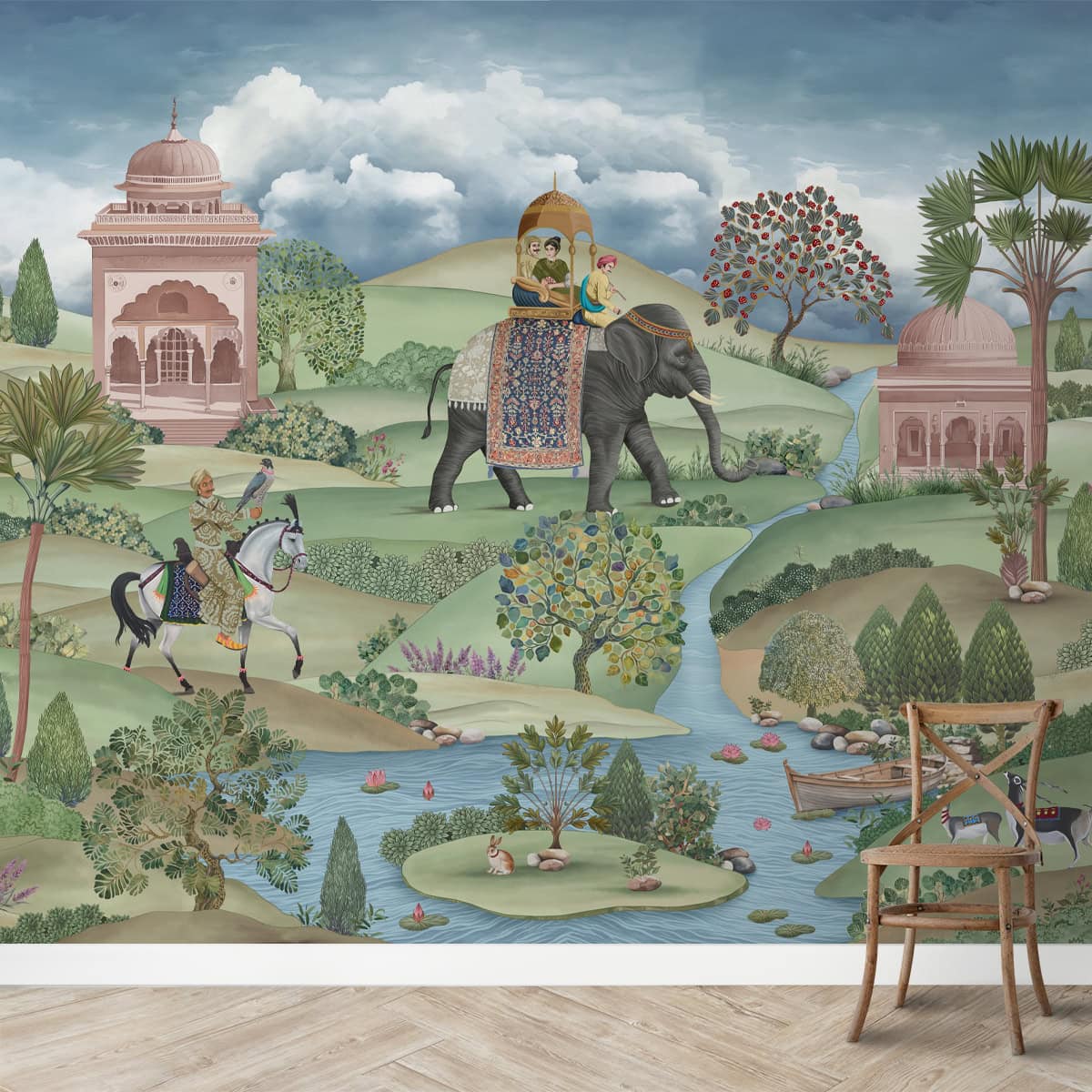
Indian art assigns animals specific roles, refined through repetition and context rather than fixed explanation. The elephant is associated with memory, patience, and authority tempered by control. It appears in processions, thresholds, and temple iconography as a stabilising presence. The tiger represents force and guardianship, often positioned at the edges of sacred spaces, marking boundaries rather than spectacle. The peacock is tied to cycles of rain and regeneration, its form recurring in architecture, textiles, and painting.
These meanings were not invented for aesthetics. They were shaped by observation, belief systems, and geography. When animal wallpaper draws from these figures, it carries this accumulated understanding forward. The animal does not function as an image alone. It functions as a reference point.
Walls as Narrative Surfaces
Indian architecture has long treated walls as active surfaces. In palaces, animals appeared across ceilings and corridors, carved into stone or painted into frescoes. Lions guarded entrances. Elephants marched across friezes. Birds occupied borders and niches. These were not ornamental flourishes meant to fill space. They communicated power, order, protection, and lineage.
In this context, animal wallpaper becomes a continuation of architectural thinking rather than a departure from it. Pattern replaces carving. Print replaces pigment. But the intent remains consistent: the wall participates in meaning-making.
BRAHM’s animal wallpaper designs draw from this architectural lineage. The scale of the animal, its placement within the pattern, and its relationship to negative space are all considered. The result is wallpaper that feels integrated rather than applied.
Craft as the Original Medium
Before industrial printing, animals appeared through labour-intensive craft. Miniature painters worked with brushes fine enough to render fur and feather through layered pigment. Textile artisans carved animals into wooden blocks, printing them repeatedly across cloth with disciplined alignment. Stone carvers translated anatomy into relief, reducing form without losing presence.
This emphasis on process matters. Even today, compelling animal wallpaper begins with drawing, not software. It requires understanding posture, movement, and proportion, as well as cultural context. An elephant rendered incorrectly does not simply look wrong. It disrupts meaning.
At BRAHM, each animal wallpaper design begins with research into historical sources, murals, manuscripts, and textiles. Animals are studied not as illustrations but as symbols shaped by use. The translation into wallpaper respects this origin.
The Role of Restraint
One of the defining characteristics of Indian animal wallpaper is restraint. Animals are rarely exaggerated or hyper-detailed. They are stylised, composed, and integrated into pattern. This restraint is not minimalism. It is discipline.
The tiger does not roar from the wall. It holds its ground. The elephant does not charge. It stands. The peacock does not overwhelm through colour alone. Its form carries rhythm and repetition. This approach allows animal wallpaper to coexist with architecture and furniture without becoming intrusive.
Restraint is what gives these designs longevity. They do not rely on novelty or visual shock. They rely on proportion and meaning.
Indian Wallpaper and the Natural Order
Animal wallpaper sits within a broader Indian design tradition that does not separate nature from culture. Indian wallpaper, whether floral, animal-led, or traditional, treats plants, animals, and humans as part of the same visual system.
This perspective is evident across centuries of art. Forests appear alongside palaces. Animals share space with deities. Nature is not framed as scenery but as structure. Animal wallpaper inherits this worldview, offering interiors a way to reconnect with it.
Rather than depicting wilderness as distant or untouchable, Indian animal wallpaper presents animals as familiar presences, shaped by proximity and understanding rather than spectacle.
Technology as Translation
Modern printing techniques allow animal wallpaper to achieve precision and scale once limited to murals or frescoes. Fine linework, layered tones, and expansive repeats can now be produced consistently. This makes it possible to bring historically scaled imagery into contemporary interiors.
However, technology functions best when it serves intention. When animal wallpaper begins with hand-drawn studies and cultural research, digital tools become a means of accuracy rather than replacement. They ensure consistency while preserving depth.
This balance is essential. Without it, animal imagery risks becoming generic. With it, animal wallpaper retains specificity and relevance.
Living With Animal Wallpaper
To live with animal wallpaper is to live with imagery that carries weight without excess. These designs establish an atmosphere through presence rather than dominance. They do not compete with space. They define it.
In living rooms, animal wallpaper can provide structure and identity. In studies, it introduces focus and grounding. In bedrooms, it offers a sense of continuity rather than distraction. The animal becomes part of the spatial logic, not a feature layered on top.
This adaptability is what allows animal wallpaper to move across contexts without losing meaning.
Beyond Trend and Theme
Animal imagery often risks being treated as a theme rather than a language. Indian animal wallpaper avoids this by grounding itself in tradition rather than novelty. It does not aim to follow interior trends. It draws from a visual system that predates them.
This is why animal wallpaper continues to resonate. It does not require explanation to feel appropriate. Its references are embedded deeply enough to register intuitively.
Choosing animal wallpaper is not about making a statement. It is about aligning a space with ideas that have endured because they remain structurally relevant.
Where Heritage Meets Contemporary Living
In modern homes, animal wallpaper acts as a bridge rather than a contrast. It brings historical symbolism into present-day spaces without turning them into replicas of the past. The imagery adapts to modern scale, materials, and light, while retaining its conceptual grounding.
BRAHM’s animal wallpaper is designed with this balance in mind. Each pattern acknowledges its source while responding to contemporary interiors. The result is wallpaper that feels considered rather than nostalgic.
The Wild, Reconsidered
The making of animal wallpaper at BRAHM remains rooted in patience and research. Sketching, refinement, and study precede production. Each design is treated as part of an ongoing visual conversation rather than a standalone product.
Modern methods complete what traditional processes begin, ensuring clarity and durability while respecting origin. The animal remains central, not as spectacle, but as structure.
Featured Animal Wallpapers
Walls That Carry Memory
Animal wallpaper is not about embellishment. It is about remembering how walls once functioned as carriers of belief, observation, and order. It brings that function back into the home without excess or performance.
Explore BRAHM’s collection of animal wallpaper, alongside Indian wallpaper, traditional designs, and floral wallpaper collections. Each reflects a fragment of India’s visual history, translated for contemporary living. These walls do not display animals for effect. They hold them as part of a system that has always connected space, culture, and meaning.



Leave a comment
This site is protected by hCaptcha and the hCaptcha Privacy Policy and Terms of Service apply.