






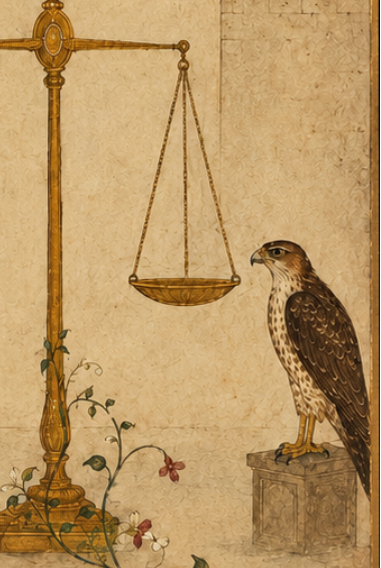
'Abhaya' King Shibi and the Scales of Dharma, Vana Parva — Canvas Cloth Print
Free worldwide shipping | US customers no surprise tariffs
 Enquire About This Piece
 Instagram
 Email
Email
Arrives Exactly as Expected
Quality Control
Every painting is carefully inspected by our team before dispatch.
If requested, we'll also send you a photo for approval before shipping.
Secure Shipping
Each piece is shipped in a rigid protective tube to reach you safely.
Our team personally inspects each piece before dispatch.
Customer Service
Our London team is on hand to assist with any queries or issues.
We resolve concerns directly to ensure your satisfaction.
Shipping Policy
Free worldwide shipping | Exempt from US tariffs
Delivered in a protective hard-case tube with full insurance to ensure it arrives safely and undamaged.
Our paintings are created using layered hand application, traditional pigments and natural binders. Drying and curing times vary depending on humidity, temperature and seasonal conditions.
Approximate Making and Shipping Timeline:
Painting production: 4 weeks
Domestic delivery (within India): 3–4 days
International delivery: 1 week
Larger custom sizes may take more than 4 weeks
Read our full delivery and fulfilment policy.
Etymology
Provenance
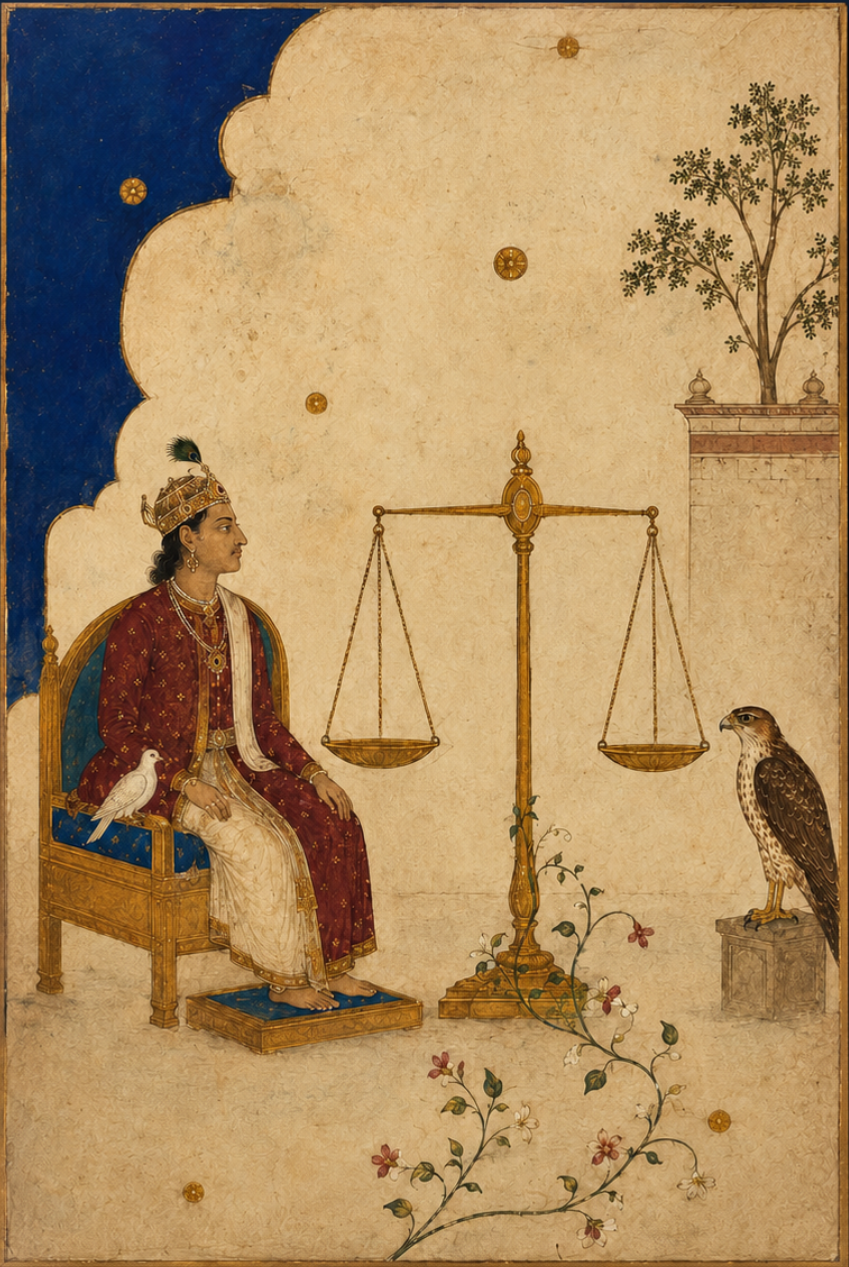
The story of King Shibi appears in the Mahabharata's Vana Parva (the Book of the Forest), in the section recounting tales of ancient kings and their dharmic conduct that Yudhishthira hears during the Pandavas' period of exile. Shibi of the Ushinaras was renowned for his liberality — his willingness to give anything, even his body, to any who asked. The gods Agni and Indra, seeking to test the limits of this reputation, take the forms of a dove and a hawk respectively. The dove, fleeing, seeks refuge in Shibi's lap. The hawk demands it be surrendered as its lawful prey. When Shibi refuses to surrender what has sought his protection, the hawk offers a counter-proposal: let Shibi substitute equivalent flesh from his own body. Shibi agrees, cuts flesh from his thigh and places it on the scale — but however much he cuts, the dove outweighs it. Finally Shibi places himself on the scale. The gods reveal themselves, restore him, and declare him supreme in dharma. The story is a Vedic instrument for exploring the absolute nature of the obligation to protect: that once protection has been granted, no personal cost can justify its withdrawal.
The visual tradition for this subject draws on the Mughal court's elaborate engagement with the Mahabharata — most notably through Akbar's Razmnama commission of 1584 — and the broader tradition of depicting royal dharma in Indian court painting. The classical Mughal miniature conventions employed here — the cream ground, the gold throne, the spare arrangement of figures, the small-scale precision of the floral vine in the foreground — situate the scene in the court painting vocabulary that the Mughals developed for royal narrative subjects. The palette — cream, crimson, and gold anchored by the cobalt blue of the sky in the upper left — is characteristic of the mature Mughal style of the late Akbar and Jahangir periods, when formal economy and chromatic precision were the highest registers of painting achievement.
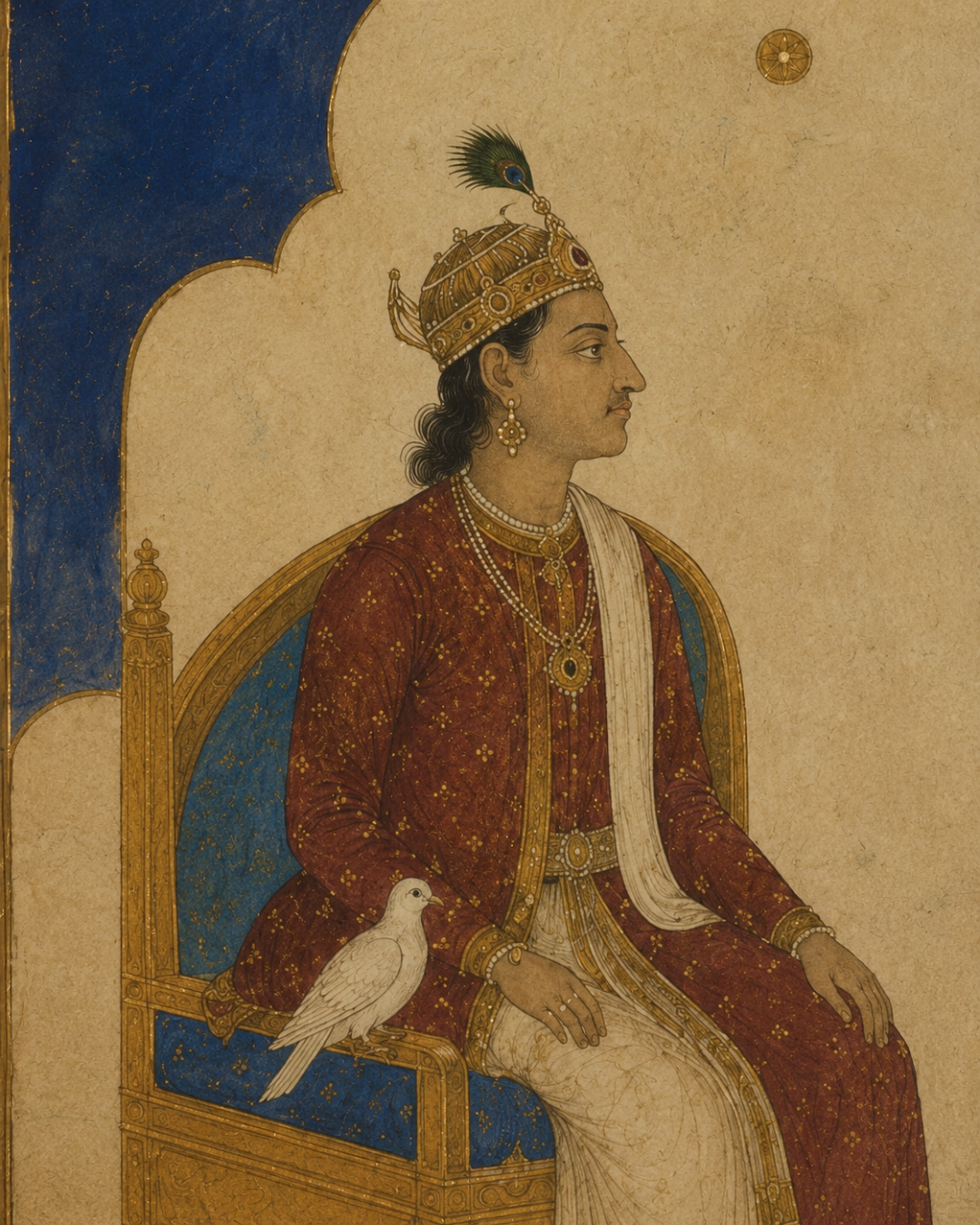
Three elements organise the composition: the king, the scale, and the hawk. Shibi sits in his golden throne at the painting's left, wearing deep crimson robes that mark him as a royal figure in the full ceremony of his power. In his lap, small and pale against the white of his garment, is the dove — the reason for everything that is about to happen. At the composition's centre, the balance scale stands on its slender column, its two empty pans hanging in equilibrium, ready for what is to come. On the right, the hawk — brown-feathered, alert, perched on a stone plinth — regards the scene with the focused attention of a predator and an examiner simultaneously. A delicate flowering vine winds across the foreground; a tree in the upper right suggests a garden, a moment of ordinary peace before the ordeal.
The story of Shibi has been read in Indian thought as a demonstration of the absolute priority of dharma over self-preservation — an illustration of what the Mahabharata terms the highest form of dāna (gift): not the gift of wealth or property but the gift of the body itself, offered without hesitation to fulfil a moral obligation. It appears in multiple versions across the Mahabharata, the Ramayana, and various Puranas, and has been depicted in Indian art from the Sanchi Stupa carvings of the first century BCE to the court paintings of the Mughal period. Its persistence as a subject reflects both the universality of its moral claim — that the obligation to protect those who seek shelter is unconditional — and the visual opportunity it offers: the scale of dharma is one of Indian painting's great recurring images, reducing an abstract philosophical principle to a single, visible object.
Disclaimer:
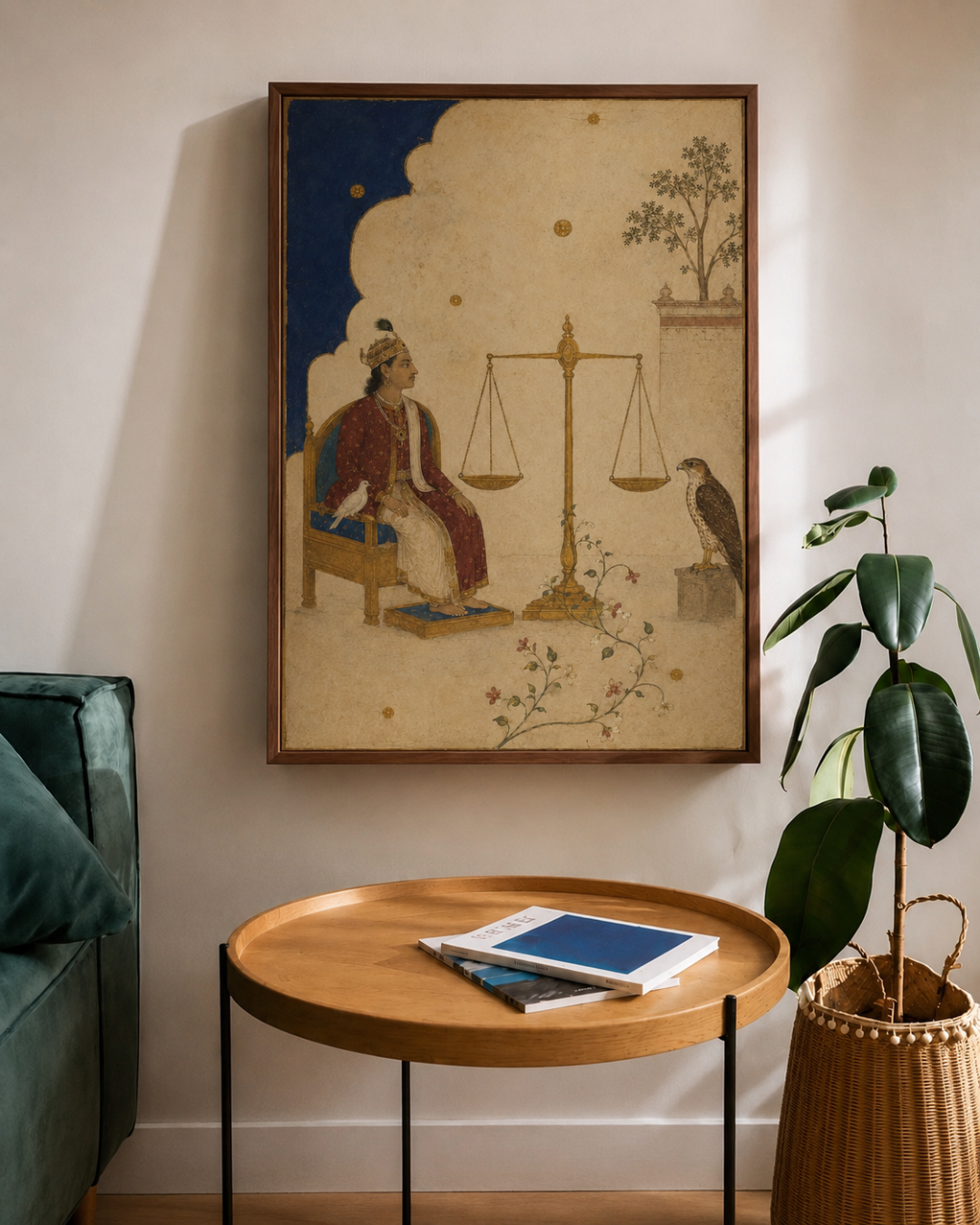
- The frames shown are for display purposes only and are not included with the artwork.
- As these are made-to-order designer pieces, expect minor colour variations from the displayed artwork.
Arrives Exactly as Expected
Quality Control
Every painting is carefully inspected by our team before dispatch.
If requested, we’ll also send you a photo for approval before shipping.
Secure Shipping
Each piece is shipped in a rigid protective tube to reach you safely.
Our team personally inspects each piece before dispatch.
Customer Service
Our London team is on hand to assist with any queries or issues.
We resolve concerns directly to ensure your satisfaction.
Choose options