









'Divyadrishti' The Divine Sight, Bhagavad Gita Chapter Eleven — Canvas Cloth Print
Free worldwide shipping | US customers no surprise tariffs
 Enquire About This Piece
 Instagram
 Email
Email
Arrives Exactly as Expected
Quality Control
Every painting is carefully inspected by our team before dispatch.
If requested, we'll also send you a photo for approval before shipping.
Secure Shipping
Each piece is shipped in a rigid protective tube to reach you safely.
Our team personally inspects each piece before dispatch.
Customer Service
Our London team is on hand to assist with any queries or issues.
We resolve concerns directly to ensure your satisfaction.
Shipping Policy
Free worldwide shipping | Exempt from US tariffs
Delivered in a protective hard-case tube with full insurance to ensure it arrives safely and undamaged.
Our paintings are created using layered hand application, traditional pigments and natural binders. Drying and curing times vary depending on humidity, temperature and seasonal conditions.
Approximate Making and Shipping Timeline:
Painting production: 4 weeks
Domestic delivery (within India): 3–4 days
International delivery: 1 week
Larger custom sizes may take more than 4 weeks
Read our full delivery and fulfilment policy.
Etymology
Provenance
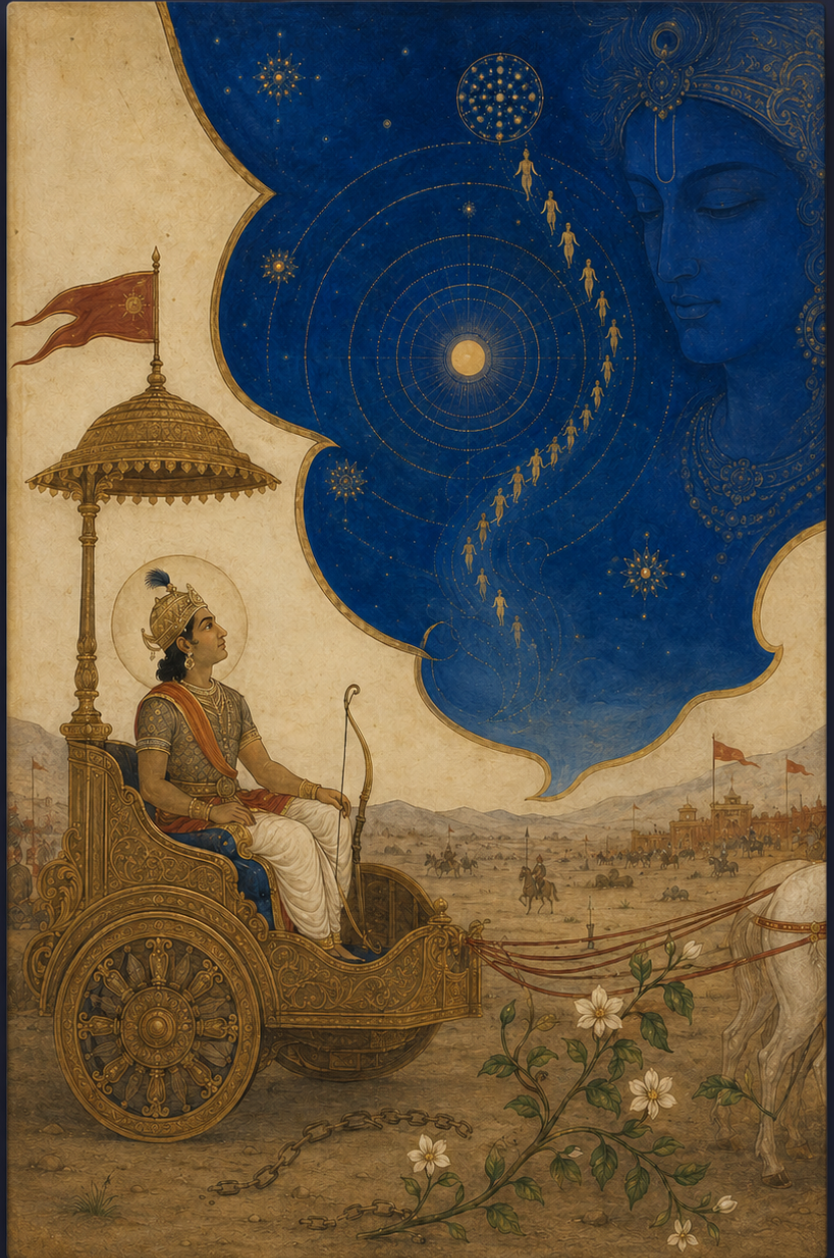
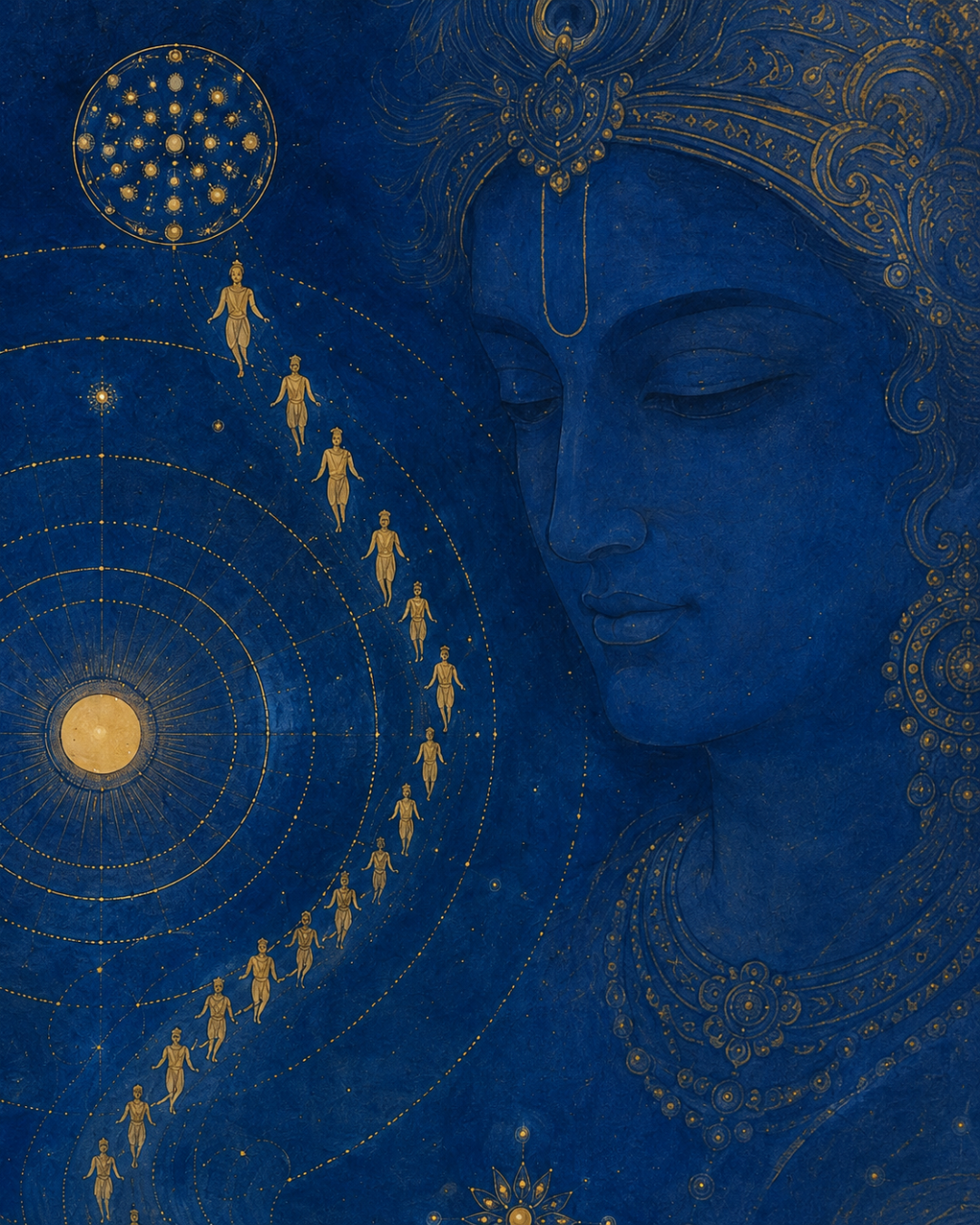
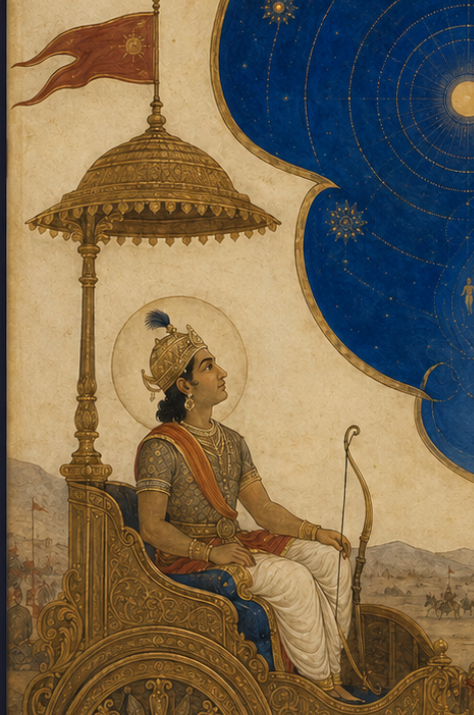
In Chapter Eleven of the Bhagavad Gita, Krishna grants Arjuna divyam chakshus — divine sight, the capacity to see what cannot be seen with human eyes. The Vishwaroopa that Arjuna then perceives is described in the text as containing all the gods, all living beings, all of creation: "all this world — I am seeing it assembled in Your body, O God" (11:7). The tradition of depicting this vision tends toward the overwhelming: the many-headed, many-armed cosmic form consuming armies, radiating like a thousand simultaneous suns. Yet the text also records that after the vision, Arjuna asks Krishna to return to his familiar four-armed form, and then to his two-armed human one — the vision being more than the human psyche can sustain. This painting chooses a different moment within that encounter: not the terrifying totality, but the instant of first comprehension — the single, vast, serene face looking down, the cosmos gathering quietly around it.
The visual language of this work draws on the early twentieth-century Indian modernist tradition — specifically the synthesis of atmospheric painterliness with a contemplative, inward register that distinguishes the Bengal School from both colonial academic painting and from the classical miniature. Painters like Abanindranath Tagore and Nandalal Bose developed an approach to sacred subjects that sought to capture the feeling of the divine encounter rather than its doctrinal content — a mood-saturated, softly atmospheric painting language quite unlike the jewelled clarity of Rajput miniature work. The influence of the Bengal School on subsequent generations of Indian painters is felt throughout this work: the soft diffusion of the cosmic field, the dream-like quality of the cobalt blue, the delicacy with which white flowers are placed in the foreground of the battlefield.
The composition is organised as two worlds: above, the cosmic — deep blue, star-scattered, traversed by rings of concentric gold that suggest the orbital patterns of worlds within worlds; below, the temporal — the cream and ochre of the battlefield, the warm gold of Arjuna's chariot, the white horse at the edge of the frame. The divine face occupies the transition between these registers, immense but serene, its eyes closed in a quality of meditative absorption rather than the open, encompassing gaze of the classical Vishwaroopa. Small human forms descend along the cosmic circles, referencing the Gita's teaching that all souls move constantly within the divine order. The white flowers placed in the foreground — wild, small, rooted in the dust of Kurukshetra — introduce the intimate and the mortal at the foot of the infinite.
The Bhagavad Gita insists that the vision of the Vishwaroopa is both culminating and temporary — after it, life continues, action is required, and Krishna takes back his human form. Indian painters have returned to this scene not because it is resolved but because it is not: the encounter with the absolute leaves the human figure intact but changed, and the task of representing that change without reducing it is what generates, across centuries, the extraordinary variety of Vishwaroopa depictions in Indian art. This painting takes the position that the most profound moment in the encounter is not the overwhelming display but the quiet comprehension — the moment when Arjuna begins to understand what it is he is seeing.
Disclaimer:
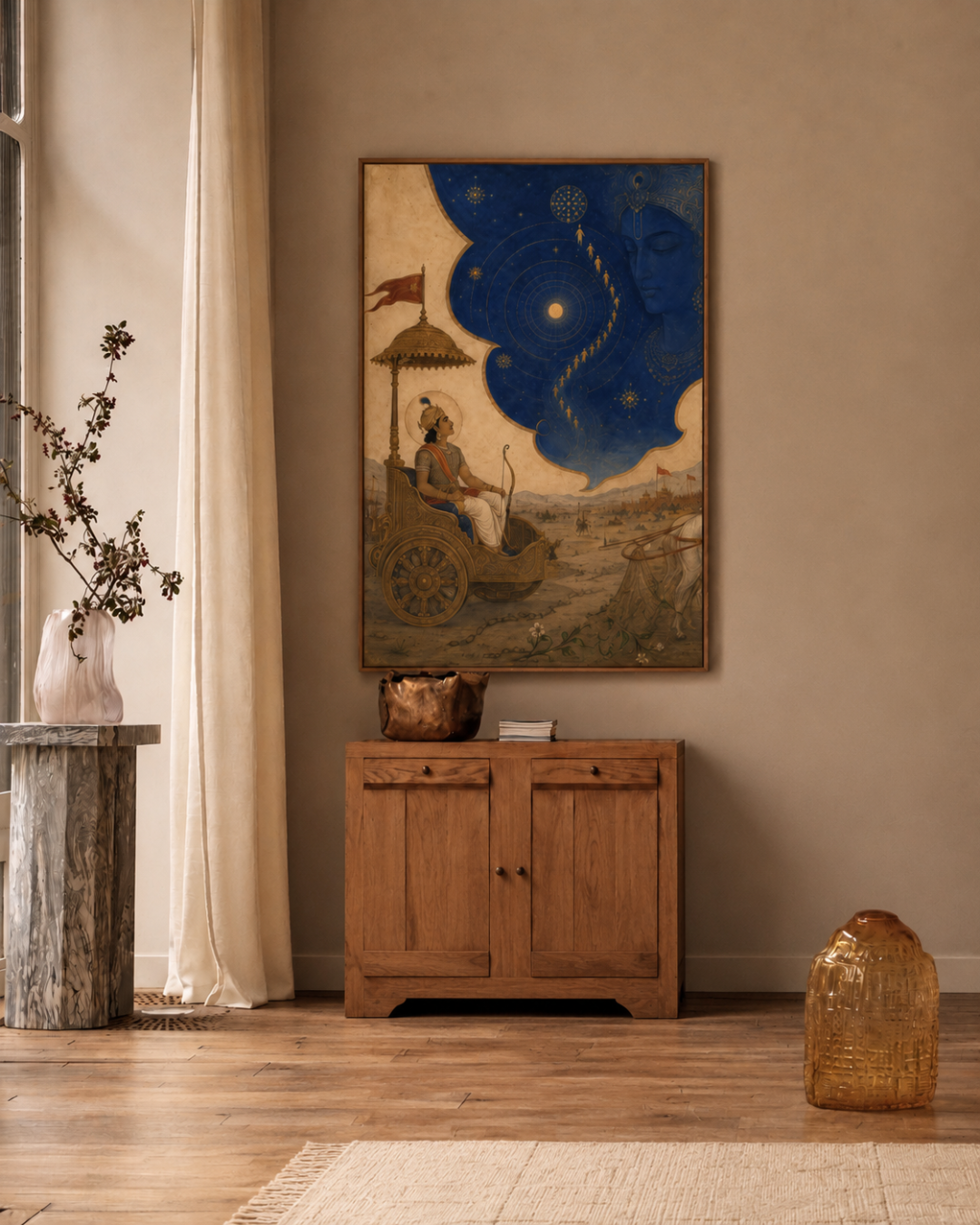
- The frames shown are for display purposes only and are not included with the artwork.
- As these are made-to-order designer pieces, expect minor colour variations from the displayed artwork.
Arrives Exactly as Expected
Quality Control
Every painting is carefully inspected by our team before dispatch.
If requested, we’ll also send you a photo for approval before shipping.
Secure Shipping
Each piece is shipped in a rigid protective tube to reach you safely.
Our team personally inspects each piece before dispatch.
Customer Service
Our London team is on hand to assist with any queries or issues.
We resolve concerns directly to ensure your satisfaction.
Choose options