







'Manthan' The Churning of the Ocean of Milk — Canvas Cloth Print
Free worldwide shipping | US customers no surprise tariffs
 Enquire About This Piece
 Instagram
 Email
Email
Arrives Exactly as Expected
Quality Control
Every painting is carefully inspected by our team before dispatch.
If requested, we'll also send you a photo for approval before shipping.
Secure Shipping
Each piece is shipped in a rigid protective tube to reach you safely.
Our team personally inspects each piece before dispatch.
Customer Service
Our London team is on hand to assist with any queries or issues.
We resolve concerns directly to ensure your satisfaction.
Shipping Policy
Free worldwide shipping | Exempt from US tariffs
Delivered in a protective hard-case tube with full insurance to ensure it arrives safely and undamaged.
Our paintings are created using layered hand application, traditional pigments and natural binders. Drying and curing times vary depending on humidity, temperature and seasonal conditions.
Approximate Making and Shipping Timeline:
Painting production: 4 weeks
Domestic delivery (within India): 3–4 days
International delivery: 1 week
Larger custom sizes may take more than 4 weeks
Read our full delivery and fulfilment policy.
Etymology
Provenance
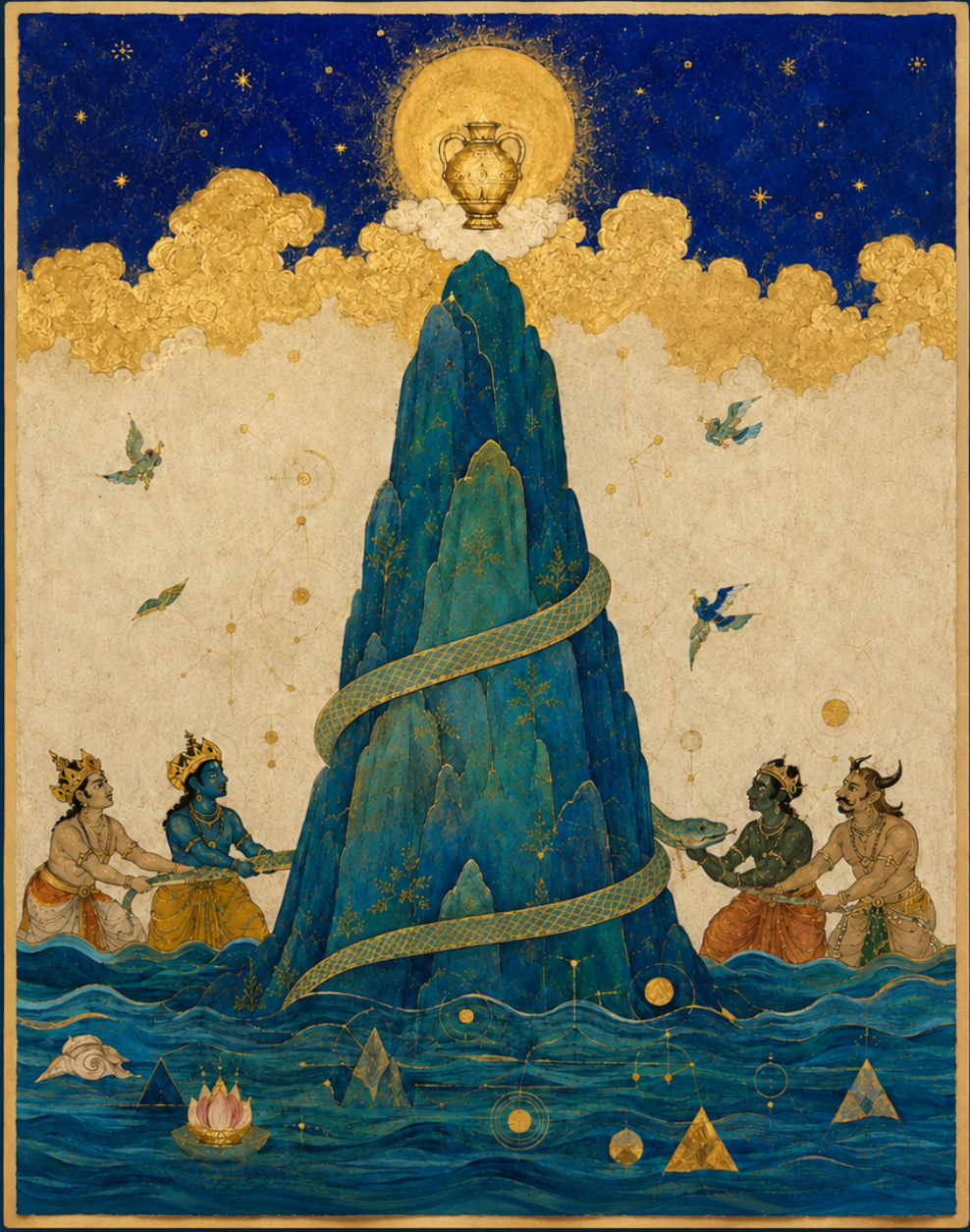
The Samudra Manthan — the churning of the ocean of milk — is among the foundational cosmological narratives of the Vedic tradition, appearing in the Vishnu Purana, the Bhagavata Purana, and the Mahabharata's Adi Parva with significant variations but a constant central premise: that the most essential things must be extracted through sustained effort from what appears to be chaos. The narrative describes a moment of cosmic crisis: the Devas, weakened by a curse from the sage Durvasa, seek Vishnu's guidance in recovering their power. Vishnu instructs them to churn the cosmic ocean of milk using Mount Mandara as the churning rod and Vasuki, the serpent king, as the rope. The Asuras are enlisted on the other side — their shared desire for Amrita, the nectar of immortality, creating a temporary alliance between the forces of light and darkness. From the churning emerge fourteen precious gifts, including the goddess Lakshmi, the physician Dhanvantari, the moon, the divine horse Uchhaishravas, and finally Amrita itself. The theological reading embedded in this narrative — that spiritual knowledge is produced through the disciplined agitation of the material world — has made it one of the most enduring images in the Indian iconographic tradition.
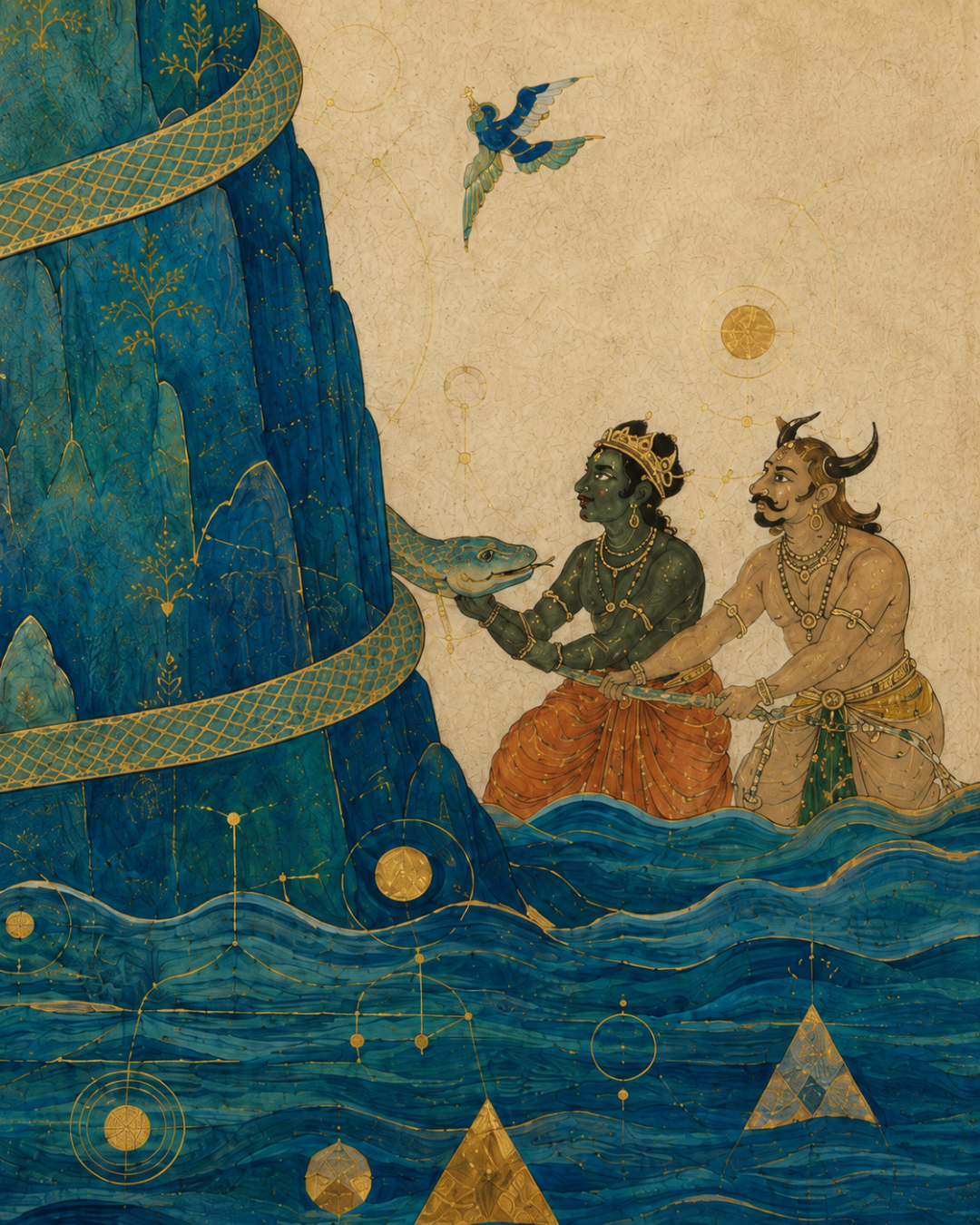
The painting's visual tradition draws on the Mughal imperial painting school's engagement with mythological narrative — a tradition that began in earnest with Akbar's court and the production of illustrated manuscripts of the Bhagavata Purana. The flat cobalt of the cosmic ocean, the gold-leafed clouds that frame the Amrita kumbha at the peak, the careful compositional symmetry that mirrors the Devas and Asuras as formal counterparts — these elements have direct antecedents in Mughal manuscript illustration. What the contemporary rendering adds is a layer of geometric abstraction in the ocean's lower register: triangles, circles, and mandala forms float beneath the surface, not as representation of specific objects from the narrative but as a visual encoding of the Vedic cosmological framework within which the churning takes place. The forms reference the sacred geometry of the yantra tradition, placing the mythological event within the larger philosophical architecture it encodes.
The composition is organised around the vertical axis of the mountain — which is also, symbolically, the axis mundi around which the cosmos turns. Mandara rises from the ocean as a clean teal pyramid, its surface scattered with gold details suggesting the starfields that surround it; Vasuki is rendered as a single elegant coil rather than the chaos of a serpent under tension, the rope transformed into a formal arc. Vishnu's blue-skinned form and another Deva occupy the left side, their golden crowns and jewellery contrasting with the darker complexion and horned crowns of the Asuras on the right. The gold kumbha at the summit, surrounded by a lunar halo and dense golden cloud, creates an apex that the eye finds and rests on: the promise that makes the labour of churning meaningful. Blue birds fly across the mid-register, and in the water below a pink lotus floats — a quiet announcement of Lakshmi's emergence to come.
The Samudra Manthan has proved perennially compelling to Indian visual artists not only because of the spectacular imagery the narrative demands but because of what it encodes about the nature of creative effort and the production of value. The message that cooperation between opposing forces is necessary to produce what is most essential; that the ocean must be disturbed before it yields its gifts; that even the god of death must be absorbed into the process — these are ideas that have given the Samudra Manthan a life far beyond its narrative context. It is referenced in Vedic philosophy, in Ayurvedic medicine, and in the political thinking of the Arthashastra. That it continues to attract painters is unsurprising: it is, among other things, a myth about the production of beauty from effort.
Disclaimer:
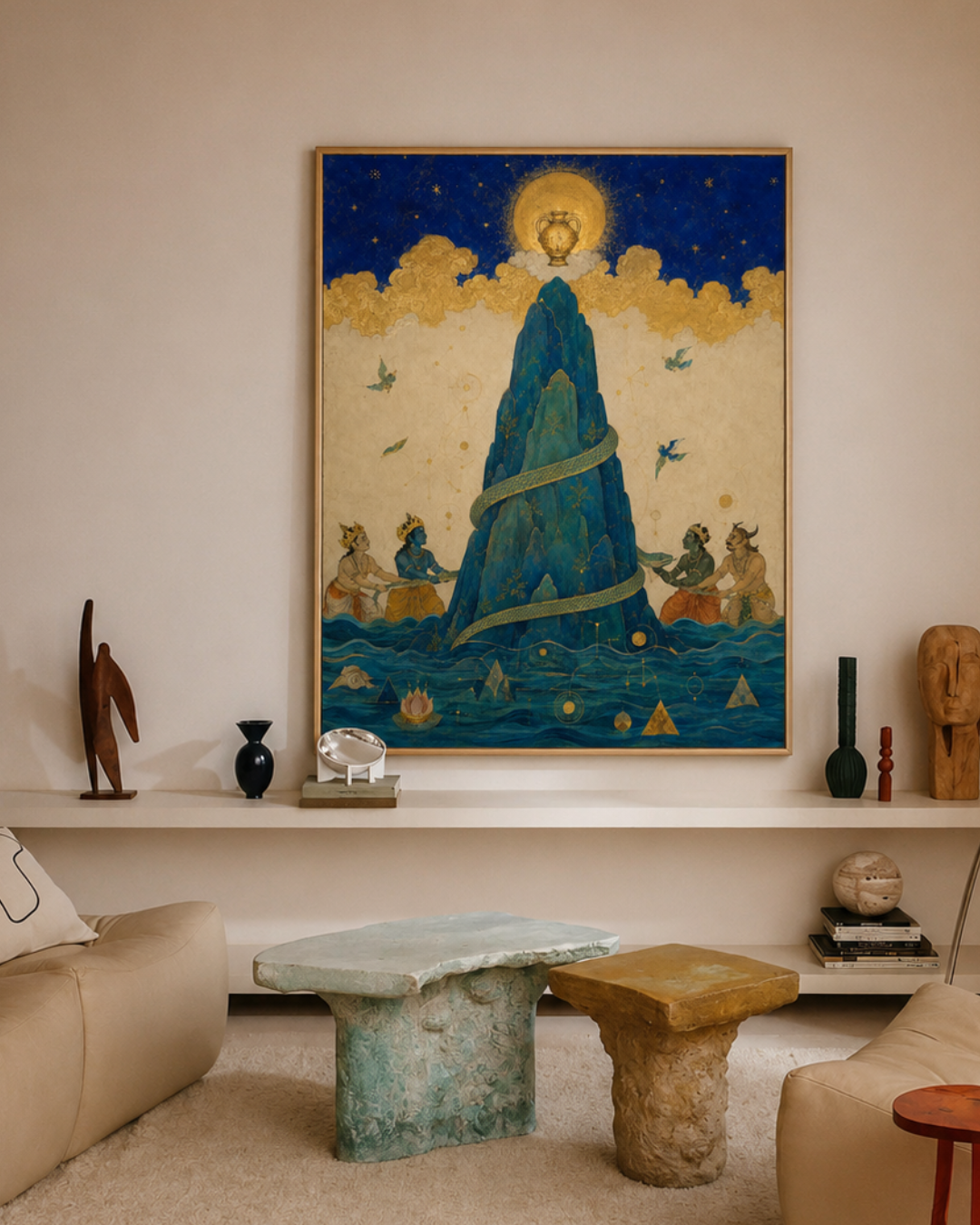
- The frames shown are for display purposes only and are not included with the artwork.
- As these are made-to-order designer pieces, expect minor colour variations from the displayed artwork.
Arrives Exactly as Expected
Quality Control
Every painting is carefully inspected by our team before dispatch.
If requested, we’ll also send you a photo for approval before shipping.
Secure Shipping
Each piece is shipped in a rigid protective tube to reach you safely.
Our team personally inspects each piece before dispatch.
Customer Service
Our London team is on hand to assist with any queries or issues.
We resolve concerns directly to ensure your satisfaction.
Choose options