







'Tirtha' Yama and Yamuna at the Sacred River — Canvas Cloth Print
Free worldwide shipping | US customers no surprise tariffs
 Enquire About This Piece
 Instagram
 Email
Email
Arrives Exactly as Expected
Quality Control
Every painting is carefully inspected by our team before dispatch.
If requested, we'll also send you a photo for approval before shipping.
Secure Shipping
Each piece is shipped in a rigid protective tube to reach you safely.
Our team personally inspects each piece before dispatch.
Customer Service
Our London team is on hand to assist with any queries or issues.
We resolve concerns directly to ensure your satisfaction.
Shipping Policy
Free worldwide shipping | Exempt from US tariffs
Delivered in a protective hard-case tube with full insurance to ensure it arrives safely and undamaged.
Our paintings are created using layered hand application, traditional pigments and natural binders. Drying and curing times vary depending on humidity, temperature and seasonal conditions.
Approximate Making and Shipping Timeline:
Painting production: 4 weeks
Domestic delivery (within India): 3–4 days
International delivery: 1 week
Larger custom sizes may take more than 4 weeks
Read our full delivery and fulfilment policy.
Etymology
Provenance
The dialogue between Yama and Yamuna is among the earliest philosophical exchanges recorded in the Vedic canon, found in the Yajur Veda and referenced in the Atharva Veda, predating by centuries the great dialogues of the Upanishads and the Bhagavad Gita. Yama and Yamuna are twins — children of Surya, the sun — whose names encode a complementarity: Yamuna, the river that will meet the Ganges at Prayagraj, and Yama, whose name means twin, but also the regulator, the restrainer. In their Vedic dialogue, Yamuna presses Yama on the nature of death, the path of the ancestors (pitriloka), the nature of immortality (amrita), and the relationship between the living and the departed. Yama's responses in these earliest Vedic hymns anticipate the philosophical architecture later elaborated in the Katha Upanishad — where Yama again instructs a young interlocutor, Nachiketa, on the nature of the atman and its survival of death. The Yama-Yamuna exchange is, in this sense, the foundational moment in Indian philosophy's engagement with mortality: the first recorded asking of what survives.
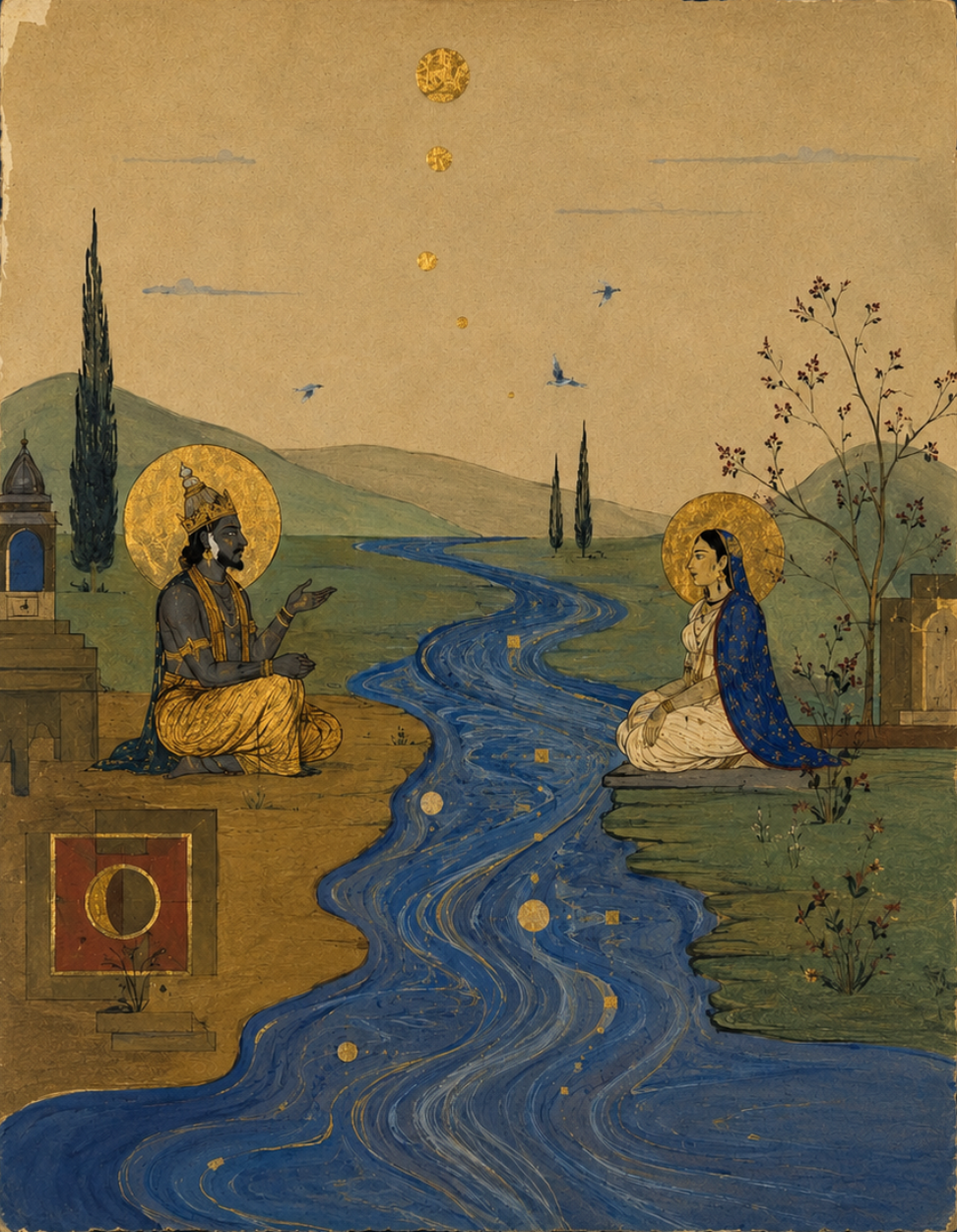
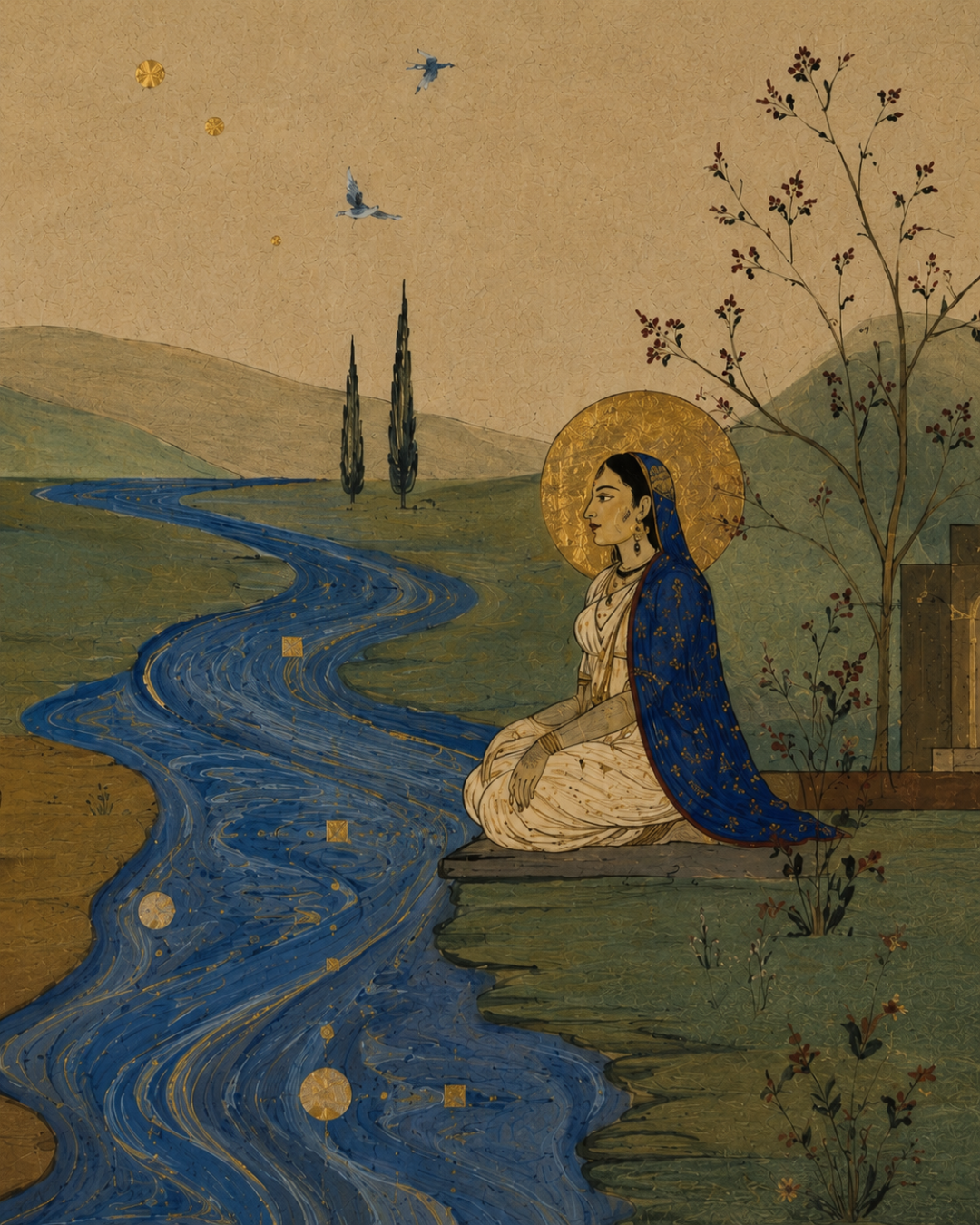
The painting's visual tradition draws on the Mughal landscape painting vocabulary that flourished from the late sixteenth century: the winding river as the compositional organising principle, the cypress and tree forms framing each figure, the small-scale architectural element establishing a sacred geography. This vocabulary — absorbed from Persian and Chinese sources and thoroughly transformed by Mughal painters into a distinctly Indian idiom — is ideally suited to a subject that is both intimate and cosmic: two figures in a landscape, the most ordinary visual situation, freighted with the most extraordinary philosophical weight. The warm sandy ground, the cobalt river, and the flowering trees behind Yamuna situate the encounter in a world recognisable as India while marking it as timeless.
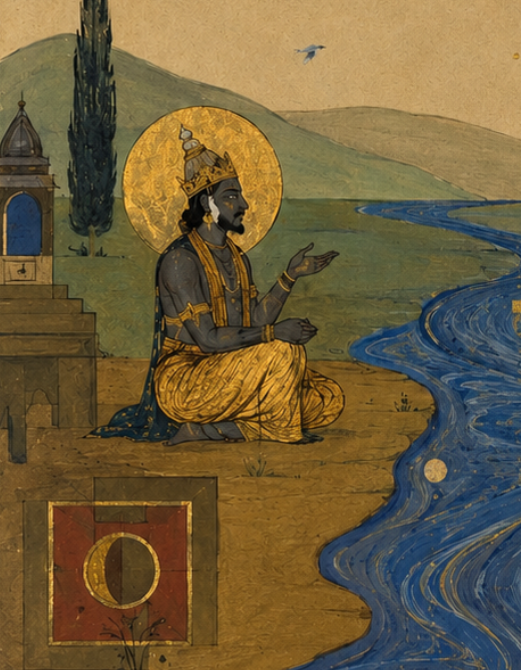
The river is the painting's protagonist. The Yamuna winds diagonally from foreground to background, its blue surface scattered with gold that suggests the souls of the departed floating on the water of time; it divides the composition not only spatially but metaphysically, placing Yama on the left bank — with the temple and the red-bordered enclosure inscribed with the symbol of his domain — and Yamuna on the right, with green grass, flowering trees, and the world of the living. The two figures are compositional mirrors of each other — both seated, both haloed, both turned inward toward the river that separates them — but in opposite registers: Yama dark, gesturing, speaking; Yamuna pale, still, receiving. The deckled edge of the paper visible at the painting's margin suggests an ancient manuscript recovered, a text whose edges have worn toward memory.
The dialogue between Yama and Yamuna has endured in the Indian philosophical tradition not because it resolves the question of death but because it opens it. Unlike the Bhagavad Gita's teaching, which moves toward clarity and resolution, this early Vedic exchange holds the question open — the river continues to flow, neither bank dissolved into the other, the distance maintained. Indian painters who have returned to this subject have been drawn to precisely this quality of unresolvedness: the dialogue continues, and the question that animates the oldest philosophical tradition in the world remains exactly as alive as it was when it was first asked. To place this painting in a room is to place that question in the room — quietly, in the company of a winding river and two haloed figures sitting at its edge.
Disclaimer:
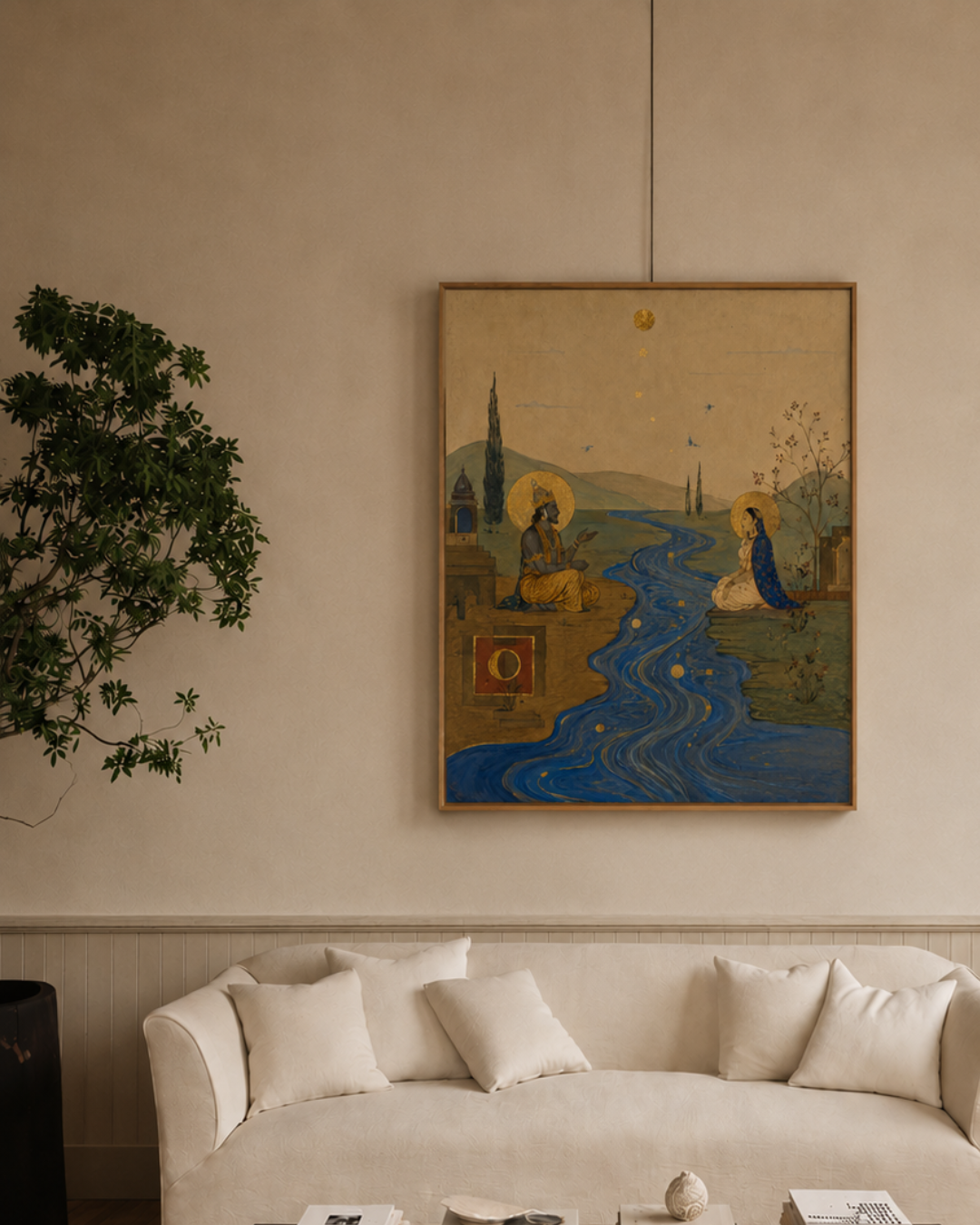
- The frames shown are for display purposes only and are not included with the artwork.
- As these are made-to-order designer pieces, expect minor colour variations from the displayed artwork.
Arrives Exactly as Expected
Quality Control
Every painting is carefully inspected by our team before dispatch.
If requested, we’ll also send you a photo for approval before shipping.
Secure Shipping
Each piece is shipped in a rigid protective tube to reach you safely.
Our team personally inspects each piece before dispatch.
Customer Service
Our London team is on hand to assist with any queries or issues.
We resolve concerns directly to ensure your satisfaction.
Choose options