









'Virat' The Cosmic Form Revealed, Bhagavad Gita Chapter Eleven — Canvas Cloth Print
Free worldwide shipping | US customers no surprise tariffs
 Enquire About This Piece
 Instagram
 Email
Email
Arrives Exactly as Expected
Quality Control
Every painting is carefully inspected by our team before dispatch.
If requested, we'll also send you a photo for approval before shipping.
Secure Shipping
Each piece is shipped in a rigid protective tube to reach you safely.
Our team personally inspects each piece before dispatch.
Customer Service
Our London team is on hand to assist with any queries or issues.
We resolve concerns directly to ensure your satisfaction.
Shipping Policy
Free worldwide shipping | Exempt from US tariffs
Delivered in a protective hard-case tube with full insurance to ensure it arrives safely and undamaged.
Our paintings are created using layered hand application, traditional pigments and natural binders. Drying and curing times vary depending on humidity, temperature and seasonal conditions.
Approximate Making and Shipping Timeline:
Painting production: 4 weeks
Domestic delivery (within India): 3–4 days
International delivery: 1 week
Larger custom sizes may take more than 4 weeks
Read our full delivery and fulfilment policy.
Etymology
Provenance
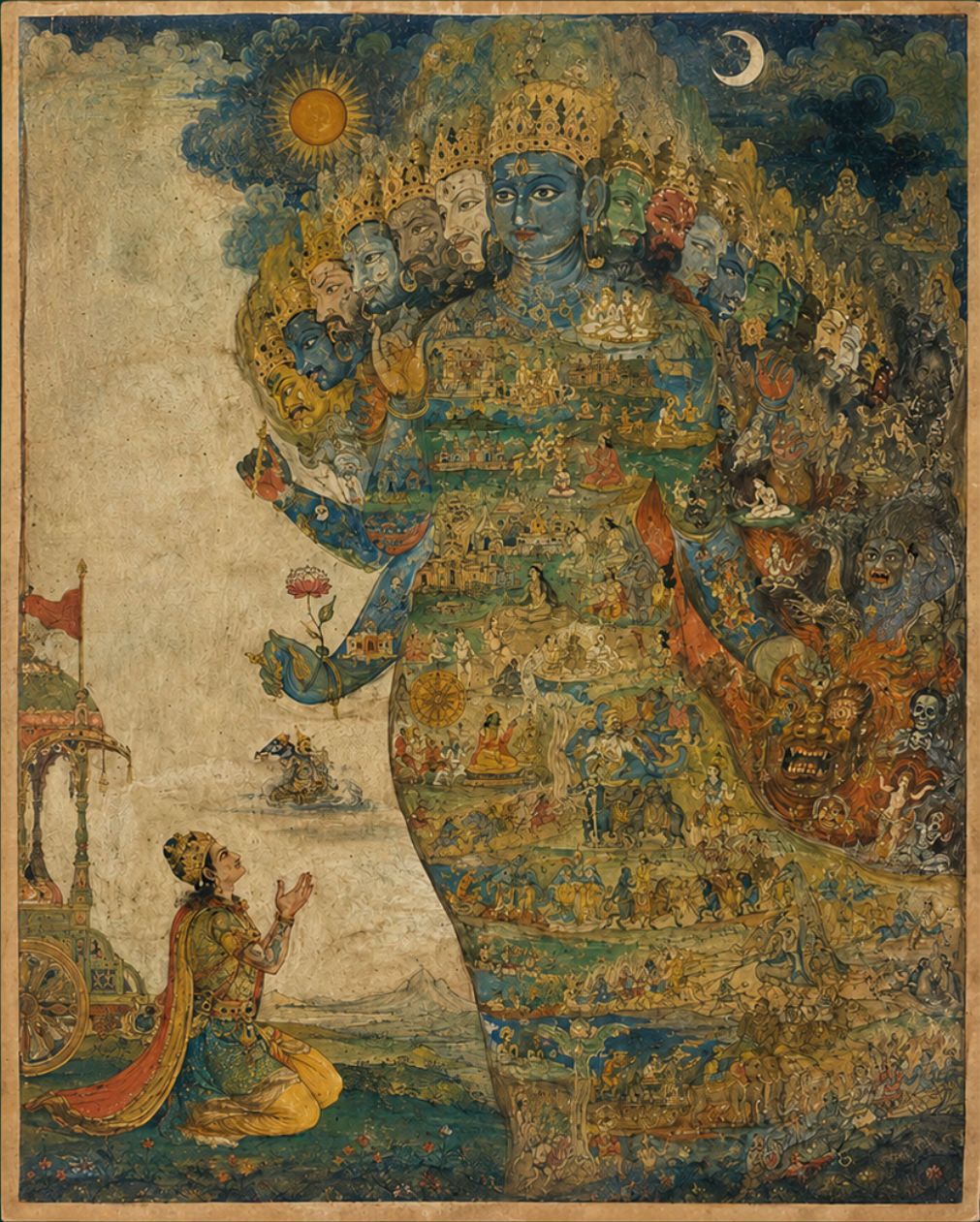
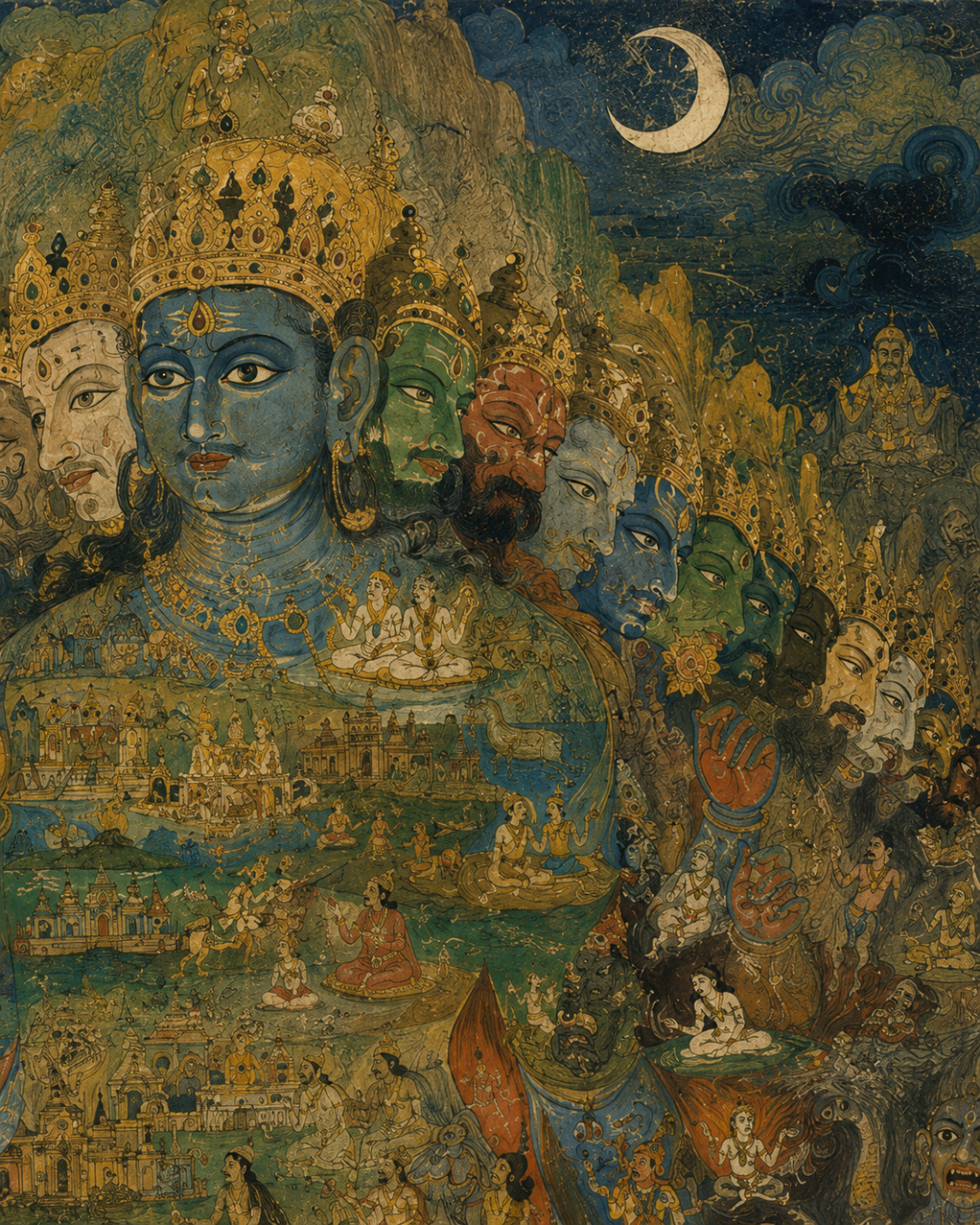
Chapter Eleven of the Bhagavad Gita — Vishwaroopa Darshan Yoga, the "Yoga of the Vision of the Universal Form" — stands as the theological climax of the text. At Arjuna's request, Krishna grants him the divyam chakshus, the divine eye, necessary to perceive what the human eye cannot contain. What Arjuna sees is both magnificent and terrible: a form of immeasurable splendour, with countless mouths, countless arms, countless eyes and faces, blazing like a thousand suns risen simultaneously. The forms of all gods and all beings dwell within it, and Arjuna witnesses the armies of both sides being drawn into Krishna's mouths — "just as the many waves of the rivers flow into the ocean, O Keshava, so do all these heroes of the mortal world flow into Your blazing mouths" (11:28). This vision, which resolves the philosophical arc of the text by placing the human within the cosmological, is one of the most elaborated descriptions of the divine in all Indian religious literature.
The visual tradition of depicting the Vishwaroopa draws directly from this chapter's insistence on multiplicity — on a form that is many things simultaneously. The classical miniature conventions used in this painting — the cream ground, the precise rendering of individual scenes within the cosmic form, the aerial perspective that allows multiple events to coexist within a single frame — are exactly suited to this demand. The Pahari school of the western Himalayas, active from the seventeenth to the nineteenth century, developed a particularly refined approach to multi-scene narrative painting, and it is their grammar — the contained vignettes, the careful delineation of the figure within the compositional frame, the earthen and mineral palette — that this work inherits and extends.
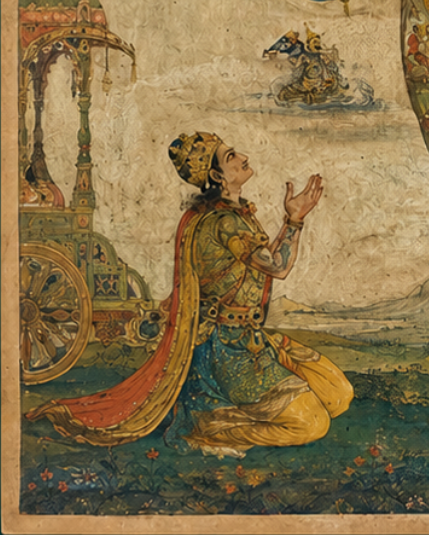
The composition is structured as a confrontation between the vast and the small. The Vishwaroopa occupies the right two-thirds of the field: the primary blue face at the apex, beneath it a crown of other faces in varying expressions, and below that the full body of the form containing within it — rendered as embedded vignettes — scenes from the heavens, the hells, the battlefield, and the world of the gods. Arjuna is placed at lower left, kneeling, his hands raised in a gesture that is simultaneously supplication and shield — the human figure reduced to near-miniature scale against the cosmic form it regards. The viewer's eye must oscillate between the particularity of the individual scenes embedded within the form and the totality of the figure that contains them — which is precisely the experience the text is describing.
The Vishwaroopa has been a compulsory subject for Indian painters since at least the sixteenth century, when Mughal emperor Akbar commissioned illustrated manuscripts of the Mahabharata (the Razmnama). The challenge the subject poses — to make visible what cannot be seen by ordinary sight — has generated some of the most inventive solutions in Indian visual art: the expanded body, the inset vignette, the golden light that cannot be source-located. This painting takes a position within that long tradition by choosing fidelity to the classical grammar of Rajput narrative painting, trusting those conventions to carry the weight of a theological image that has proved, across five centuries, impossible to exhaust.
Disclaimer:
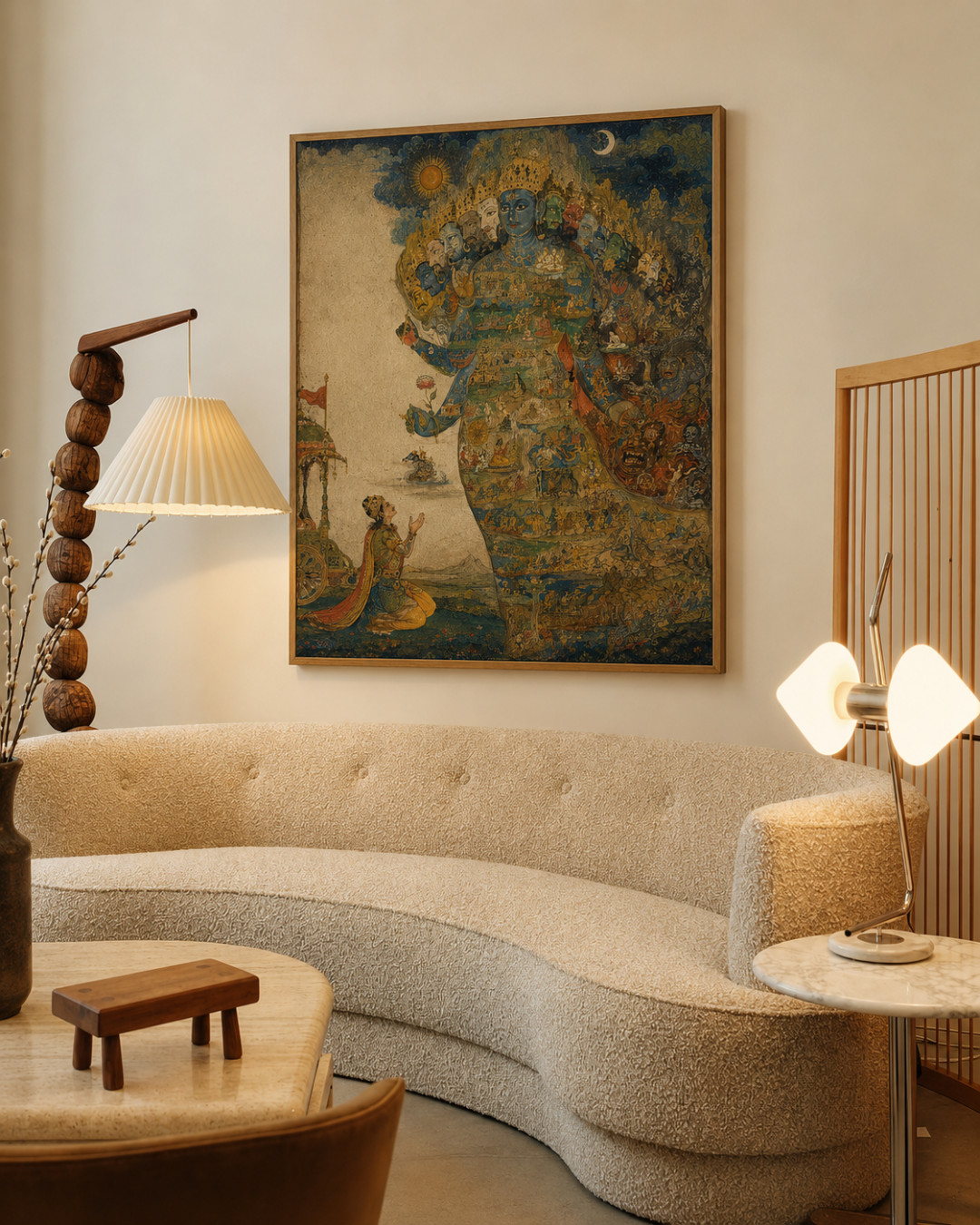
- The frames shown are for display purposes only and are not included with the artwork.
- As these are made-to-order designer pieces, expect minor colour variations from the displayed artwork.
Arrives Exactly as Expected
Quality Control
Every painting is carefully inspected by our team before dispatch.
If requested, we’ll also send you a photo for approval before shipping.
Secure Shipping
Each piece is shipped in a rigid protective tube to reach you safely.
Our team personally inspects each piece before dispatch.
Customer Service
Our London team is on hand to assist with any queries or issues.
We resolve concerns directly to ensure your satisfaction.
Choose options