







'Vishada' Arjuna's Despondency at Kurukshetra — Canvas Cloth Print
Free worldwide shipping | US customers no surprise tariffs
 Enquire About This Piece
 Instagram
 Email
Email
Arrives Exactly as Expected
Quality Control
Every painting is carefully inspected by our team before dispatch.
If requested, we'll also send you a photo for approval before shipping.
Secure Shipping
Each piece is shipped in a rigid protective tube to reach you safely.
Our team personally inspects each piece before dispatch.
Customer Service
Our London team is on hand to assist with any queries or issues.
We resolve concerns directly to ensure your satisfaction.
Shipping Policy
Free worldwide shipping | Exempt from US tariffs
Delivered in a protective hard-case tube with full insurance to ensure it arrives safely and undamaged.
Our paintings are created using layered hand application, traditional pigments and natural binders. Drying and curing times vary depending on humidity, temperature and seasonal conditions.
Approximate Making and Shipping Timeline:
Painting production: 4 weeks
Domestic delivery (within India): 3–4 days
International delivery: 1 week
Larger custom sizes may take more than 4 weeks
Read our full delivery and fulfilment policy.
Etymology
Provenance
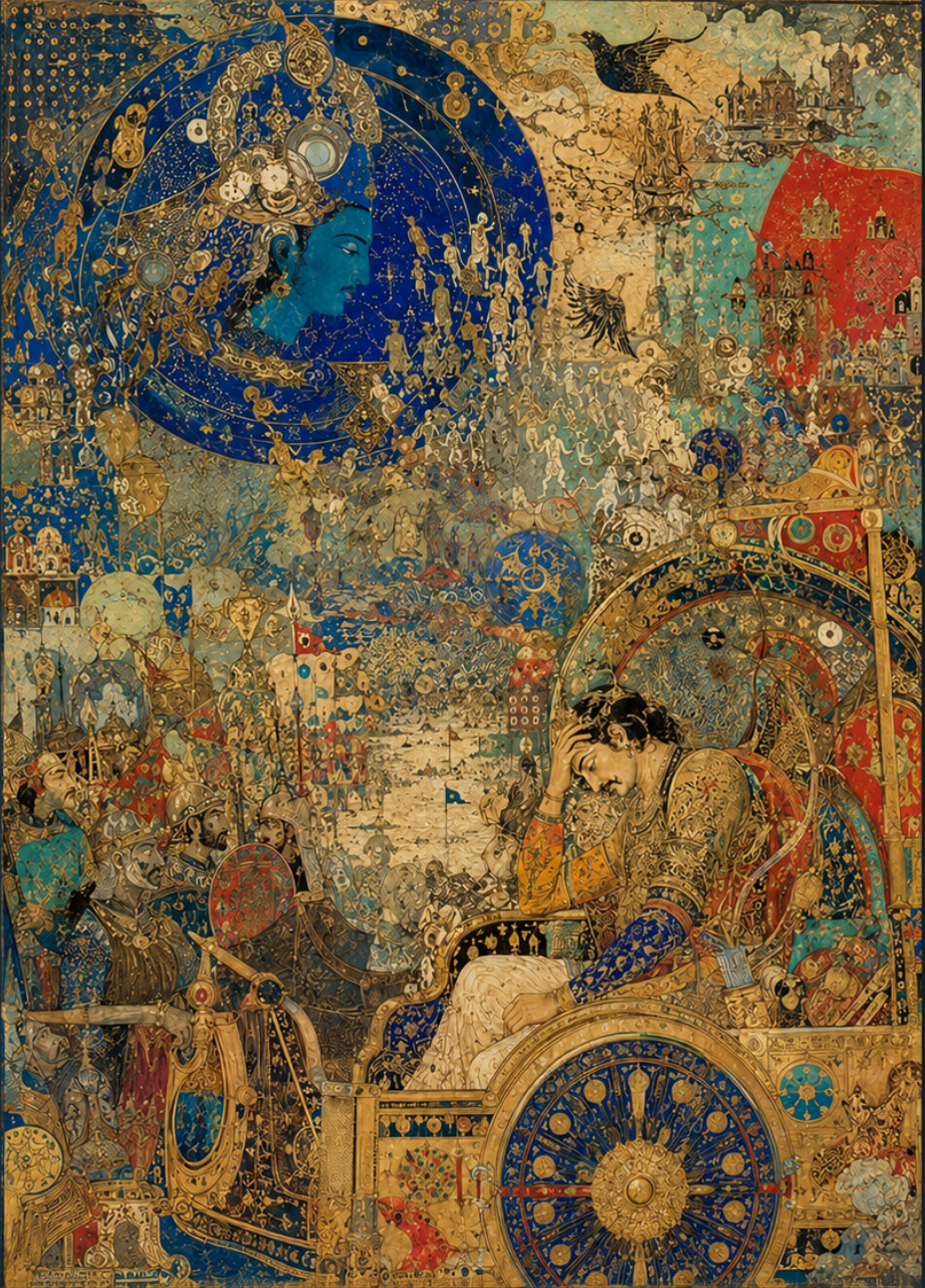
The first chapter of the Bhagavad Gita — Arjuna Vishada Yoga, the "Yoga of Arjuna's Despondency" — records the moment that precipitated one of the most sustained philosophical dialogues in world literature. On the field of Kurukshetra, Arjuna instructs his charioteer Krishna to drive between the two armies so that he might behold those against whom he is to fight. When he sees his teachers, his grandfather Bhishma, his cousins and kinsmen ranged against him, his bow falls from his hands. "My limbs fail and my mouth is parched," he tells Krishna in Chapter 1, verse 28 — "my body quivers and my hair stands on end." This collapse, which opens the Gita's eighteen chapters of instruction, is not merely psychological. The text's commentators — from Adi Shankaracharya in the eighth century to Sri Aurobindo in the twentieth — have read Arjuna's grief as the predicament of any conscious being confronting its dharma in conditions of radical moral complexity.
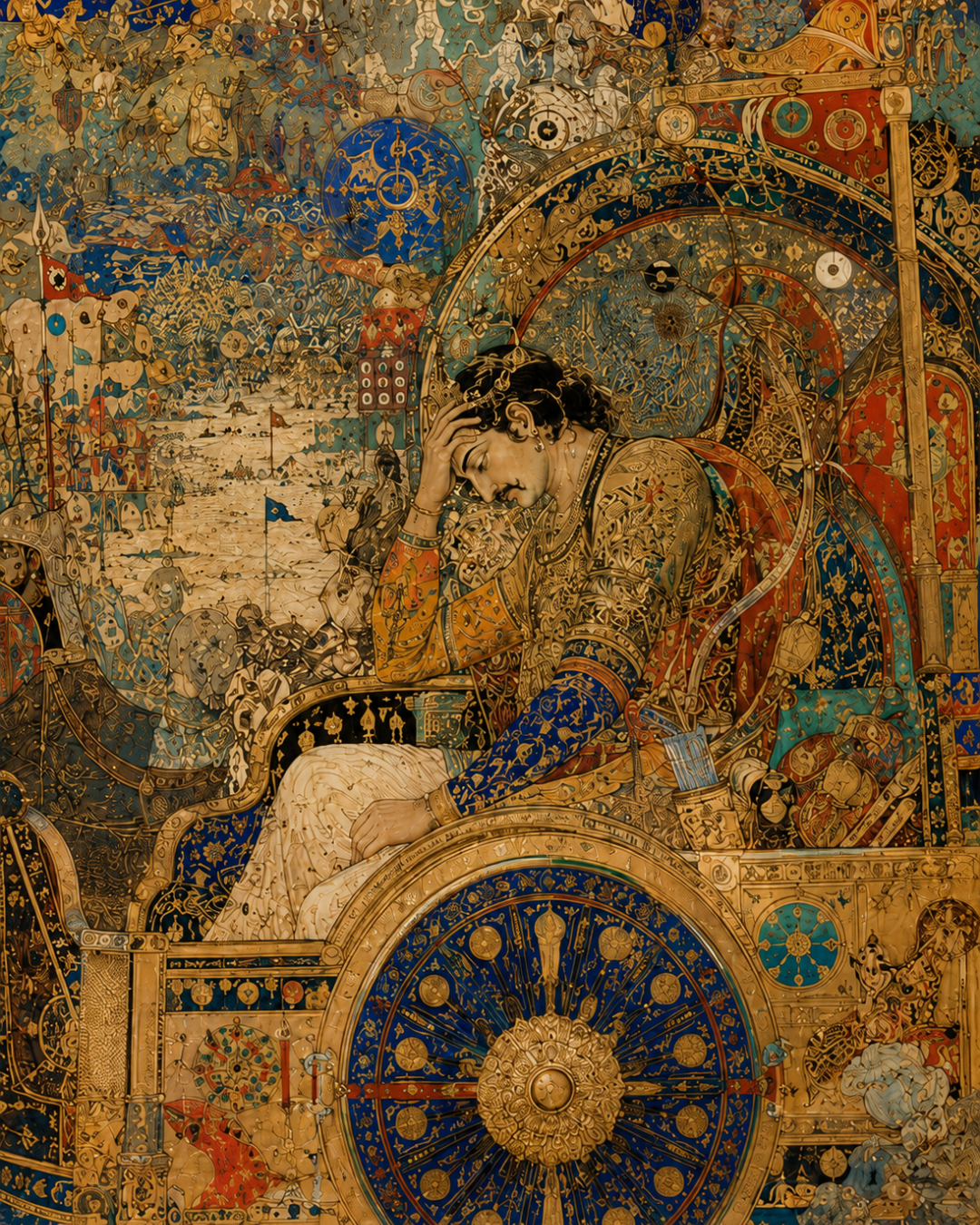
The painting draws on the vocabulary of contemporary Indian miniature art — a living tradition that synthesises the naqqashi (decorative fill-work) and compositional conventions of Mughal court painting with a more free, layered painterly surface. The background is not the flat gold or lapis ground of classical Mughal work but an allover field of dense mark-making: tiny figures, architecture, banners, and cloud forms dissolving into each other in a manner that suggests both the chaos of the battlefield and the layered texture of a sacred manuscript. Krishna's presence is rendered not as a figurative image but as a cosmic blue disc — a device that references the chakra iconography of Vaishnavite painting while placing the divine beyond the merely human scale of the scene.
The viewer's eye enters at the chariot wheel in the lower right — ornamented in gold and cobalt, unmistakably Indian in its Vedic geometry — and rises to Arjuna, who is bowed forward, head lowered, his golden ornamentation an ironic counterpoint to his posture of collapse. The lapis blue of Krishna's cosmic form at upper left pulls against this downward weight, establishing a diagonal axis of grief and divine address that structures the entire composition. Terracotta red anchors the right edge; the centre is deliberately diffuse, filled with the haze of armies and the pressure of a decision not yet made.
The scene of Arjuna's despondency has drawn Indian painters for at least five centuries — from the Razmnama illustrations commissioned by Akbar in 1584 to the nationalist painters of the twentieth century who read Arjuna's dilemma as a metaphor for India's own historical moment. Its endurance as a subject lies in its philosophical universality: the confrontation between duty and grief, action and attachment, the individual and the absolute. Rendered in this contemporary idiom, the painting asks the same question the text asks — not of a warrior on a chariot, but of anyone who looks at it.
Disclaimer:
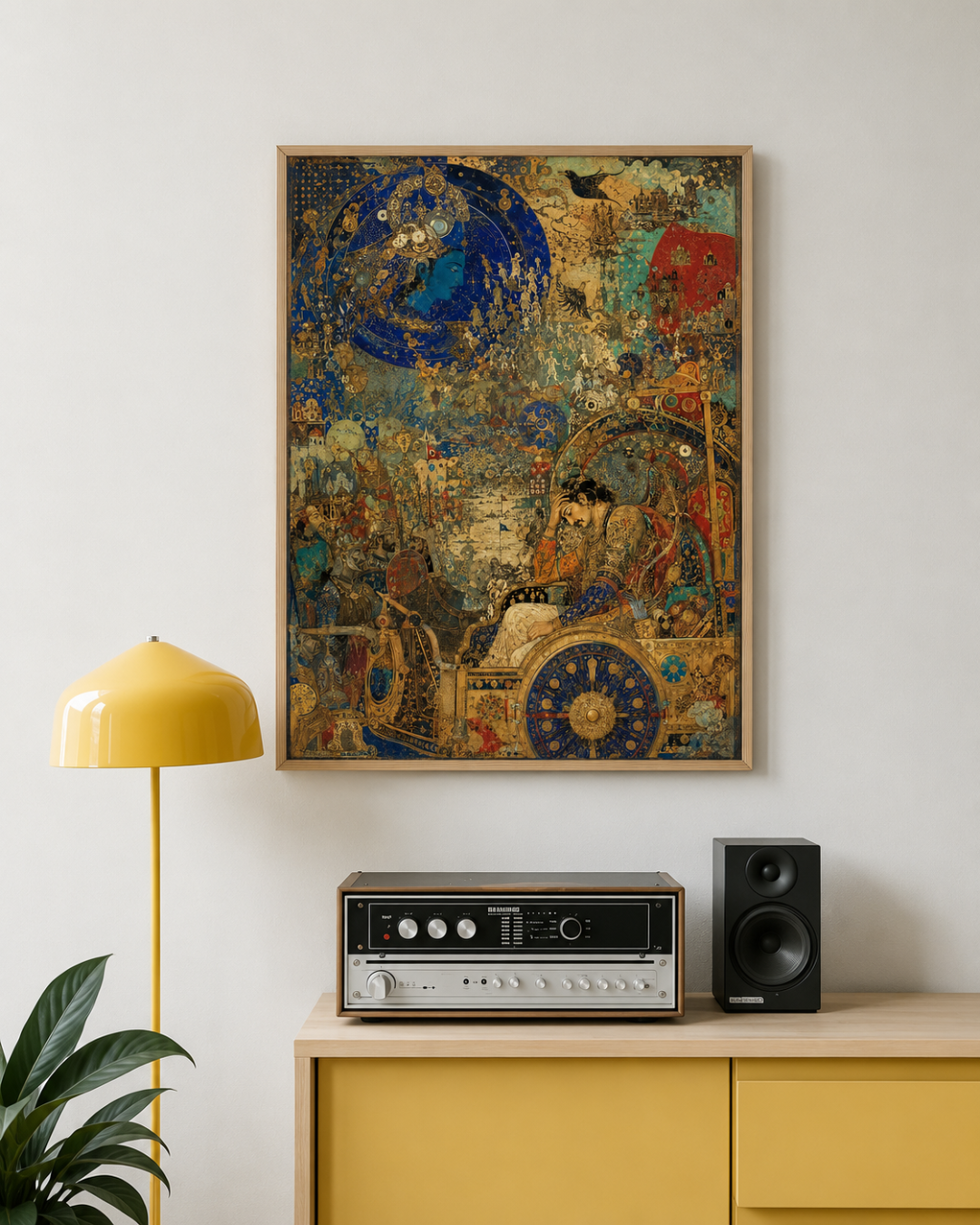
- The frames shown are for display purposes only and are not included with the artwork.
- As these are made-to-order designer pieces, expect minor colour variations from the displayed artwork.
Arrives Exactly as Expected
Quality Control
Every painting is carefully inspected by our team before dispatch.
If requested, we’ll also send you a photo for approval before shipping.
Secure Shipping
Each piece is shipped in a rigid protective tube to reach you safely.
Our team personally inspects each piece before dispatch.
Customer Service
Our London team is on hand to assist with any queries or issues.
We resolve concerns directly to ensure your satisfaction.
Choose options