







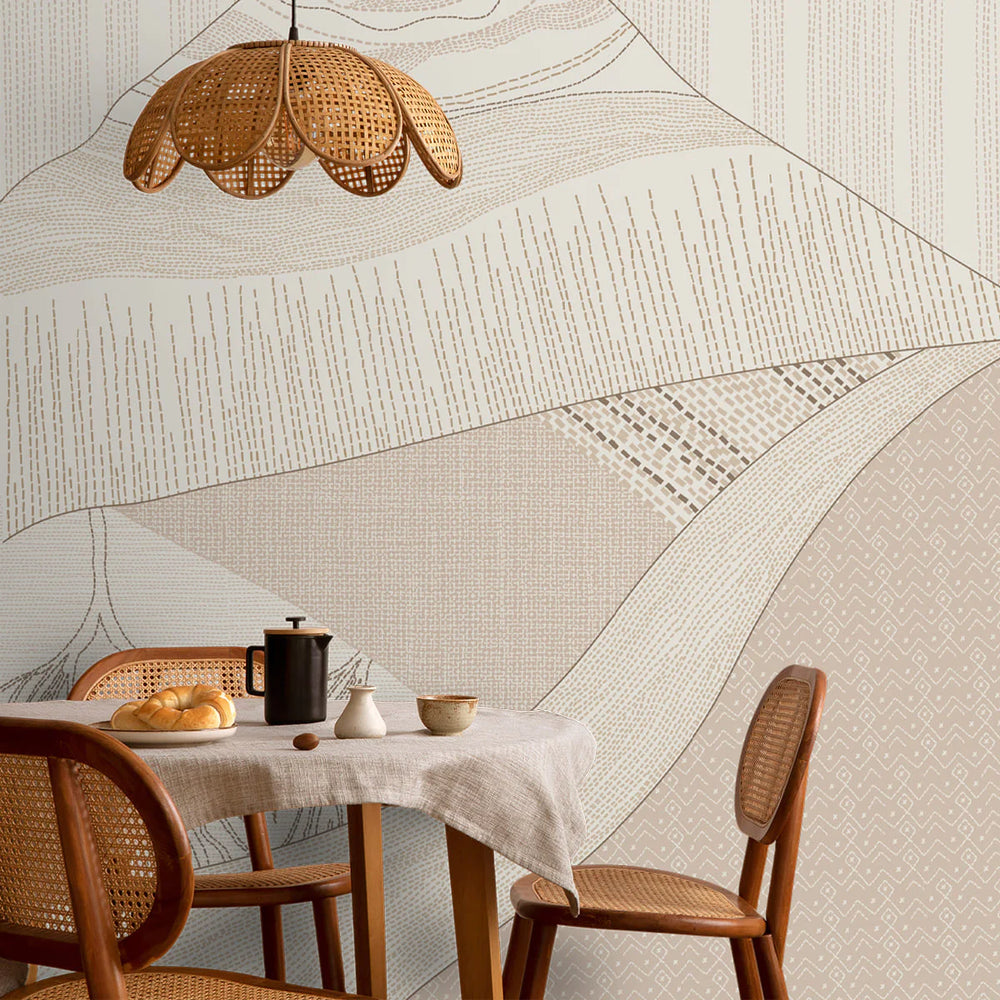
The Poetry of Imperfection: Understanding Abstract Wallpaper Through Indian Art
In Indian visual culture, perfection has never been the goal. Balance matters, discipline matters, but flawlessness does not. A line that wavers, pigment that settles unevenly, repetition that shifts by a fraction, these are signs of process, not error. Indian art has long accepted that making is a human act, and that humanity leaves traces. This understanding sits at the core of how abstract wallpaper functions when viewed through an Indian lens.
Rather than striving for sterile precision, Indian abstraction has historically embraced rhythm, intuition, and variation. When abstract wallpaper draws from this lineage, it becomes more than a contemporary design choice. It becomes a continuation of a way of thinking about form, surface, and meaning.
Abstraction Before Modernism
Abstract art is often framed as a twentieth-century Western development, linked to movements such as Cubism, Suprematism, or Abstract Expressionism. Yet abstraction as a visual language existed in India long before these movements were named.
Tantric paintings, dating from roughly the 9th to the 13th centuries and later revived in ritual practice, reduced complex cosmological ideas into minimal forms. Circles, triangles, squares, and intersecting lines were used to represent energy, creation, and the structure of the universe. These images were not decorative objects but functional tools for meditation and concentration. Their abstraction was intentional, designed to remove distraction rather than add visual interest.
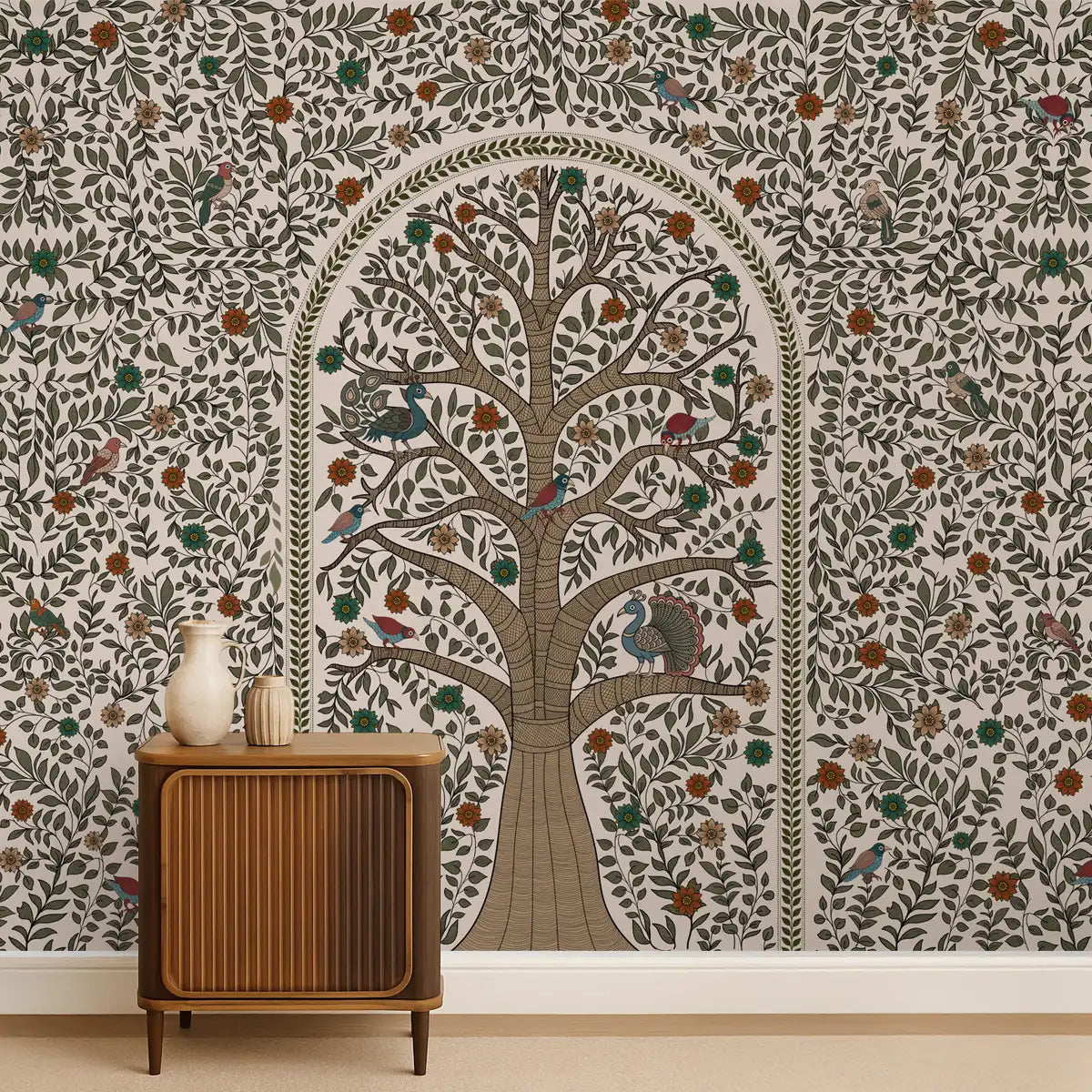
Similarly, folk traditions such as Madhubani painting rely heavily on stylisation and repetition. Human figures, animals, and natural elements are flattened, patterned, and arranged into dense geometric fields. The aim was never realistic depiction. It was symbolic clarity. Over time, these patterns became increasingly abstract, particularly when repeated across walls and floors during festivals and rituals.
Seen through this history, abstract wallpaper rooted in Indian art is not an import of modern design thinking. It is an extension of an existing visual tradition.
Tribal Aesthetics and Material Truth
Many indigenous and tribal art forms across India, including Warli, Gond, and Bhil painting, rely on abstraction shaped by material constraints. Natural pigments derived from earth, charcoal, plant matter, and minerals behave unpredictably. Lines bleed. Surfaces crack. Colours fade unevenly over time.
Rather than correcting these qualities, artists incorporated them into the work. Repetition became a way of establishing rhythm rather than uniformity. Shapes remained simple because materials demanded economy. Over generations, this produced visual systems that appear abstract by modern standards but were deeply practical and symbolic in origin.
This approach is highly relevant to contemporary abstract wallpaper. When patterns echo hand-drawn geometry, irregular spacing, or layered pigment effects, they reference these material realities. The wallpaper does not attempt to disguise process. It acknowledges it.
Geometry as Meaning, Not Ornament
Geometry in Indian art is rarely neutral. Shapes function as carriers of meaning shaped by philosophy, ritual, and spatial logic.
-
The circle represents continuity, cycles, and the infinite.
-
The square is associated with structure, order, and the material world.
-
The triangle suggests movement, energy, and transformation.
These forms appear repeatedly in yantras, mandalas, temple plans, and floor drawings such as kolam and rangoli. Over time, repetition transforms geometry into pattern, and pattern into atmosphere.
When these same shapes appear in abstract wallpaper, they carry this inherited logic, even when viewers are not consciously aware of it. A repeated grid may feel grounding because it mirrors architectural order. An irregular field of circles may feel dynamic because it reflects organic repetition rather than mechanical precision.
This is one reason abstract designs rooted in Indian geometry tend to feel stable rather than chaotic.
From Ritual Surface to Interior Wall
Historically, abstraction in India often appeared on surfaces meant to be temporary. Floor drawings erased by footsteps. Painted walls renewed annually. Ritual diagrams drawn and dissolved. Permanence was not the goal.
Abstract wallpaper changes this condition. It fixes abstraction onto a durable surface while still referencing impermanence through visual language. Weathered textures, uneven line weight, layered forms, and imperfect repetition preserve the sense of process even when the material itself is stable.
This shift makes abstract design compatible with modern interiors without severing its conceptual roots.
Folk Minimalism and Contemporary Space
Modern interior design often prioritises restraint, reduced palettes, and clarity of form. Indian abstraction aligns naturally with these values, not because it is minimal in intent, but because it has always favoured economy.
Folk abstraction simplifies without flattening meaning. A slightly off-centre circle introduces movement. A faded edge suggests time. A repeated shape that shifts subtly across a surface keeps the eye engaged without overwhelming it.
In abstract wallpaper, this balance becomes particularly effective. The wall holds visual interest without dictating how a room must be used or furnished. It supports rather than dominates.
Abstract Wallpaper as Spatial Tool
When used thoughtfully, abstract wallpaper functions as more than a decorative surface. It can influence how space is perceived.
Large-scale abstract patterns can expand visual boundaries. Repetition can stabilise irregular room layouts. Muted abstract designs can soften architectural rigidity without introducing ornament that feels excessive.
Because abstract forms do not depict literal objects, they allow rooms to remain flexible. A space does not become themed or prescriptive. Instead, it gains character through structure and rhythm.
Design Advice for Using Abstract Wallpaper
Abstract patterns are most effective when scale, tone, and placement are considered together.
-
In smaller spaces, use muted palettes and gentle geometry to maintain visual balance without compressing the room.
-
In living areas, choose abstract wallpaper that prioritises texture and form over contrast, allowing furniture and light to remain central.
-
For creative or reflective spaces, bolder motifs with visible movement can introduce energy without distraction.
Abstract wallpaper works best when it is allowed to function as a surface rather than a statement.
Between Art and Daily Life
Indian abstraction has always existed between art and use. It was never confined to galleries or treated as purely intellectual exercise. It appeared on floors, walls, textiles, and ritual objects, integrated into everyday life.
Abstract wallpaper continues this positioning. It allows abstraction to exist within lived space, responding to light, wear, and time. The wall becomes an active element rather than a passive background.
This relationship is what gives abstraction its longevity. It adapts without losing coherence.
Contemporary Interpretations
BRAHM’s abstract wallpaper collection draws directly from these histories. Designs are developed from hand-drawn studies, architectural geometry, and folk pattern systems rather than digital effects alone. Layering, variation, and texture are retained intentionally.
Modern printing techniques ensure consistency and durability, but the visual language remains rooted in process. Each pattern acknowledges that abstraction is not about removing meaning, but about refining it.
A Different Kind of Completion
Abstraction does not aim to resolve everything. It allows space for interpretation, for pause, for attention without instruction. In Indian traditions, this openness was essential. Meaning unfolded through repetition and engagement rather than immediate clarity.
Abstract wallpaper inherits this quality. It does not tell a story directly. It creates conditions for one to exist.
To live with abstraction is not to seek perfection. It is to accept variation as structure and process as presence. In this way, abstract wallpaper does not decorate a wall. It activates it.
Featured Abstract Wallpapers

Nirek Panditha
I was born and raised in Sri Lanka but I come from a half- Indian, half- Sri Lankan background. As I've grown older I've begun to recognise the importance of remembering our collective cultural heritage, be it through the stories, the arts or even craftsmanship that still holds the memory of the hands that shaped it.



Leave a comment
This site is protected by hCaptcha and the hCaptcha Privacy Policy and Terms of Service apply.