











Bringing the Outdoors In: Forest Wallpaper and the Indian Imagination
In India, the forest has never been understood as empty land. It has functioned as shelter, school, spiritual site, and social margin. Long before cities defined culture, forests shaped how people thought about time, morality, and coexistence. This relationship continues to influence Indian visual traditions, from painting and architecture to textiles and craft. Today, it finds renewed expression through forest wallpaper, where landscapes once encountered through travel and ritual are translated into interior surfaces.
Forest imagery in Indian design does not operate as scenic decoration. It carries memory, symbolism, and ecological awareness. When used thoughtfully, forest wallpaper reshapes how interiors feel, introducing depth, movement, and a sense of continuity with the natural world rather than a representation of it.
The Forest in Indian Thought
Ancient Indian texts consistently position the forest as a space of transformation. In the Ramayana and Mahabharata, exile into the forest is not punishment alone but a necessary stage of learning and self-knowledge. Buddhist traditions describe forests as sites of meditation, where the mind becomes attentive through proximity to nature rather than isolation from it.
This understanding shaped artistic representation. Forests were not painted as passive scenery. They were environments charged with presence. Trees, vines, animals, and birds appeared as active elements within narrative scenes, often arranged rhythmically rather than realistically. The goal was not illusion but participation.
When forest wallpaper draws from this lineage, it inherits a way of seeing nature as relational. The forest is not outside the home; it is something the home can open toward.
Forest Imagery in Indian Art
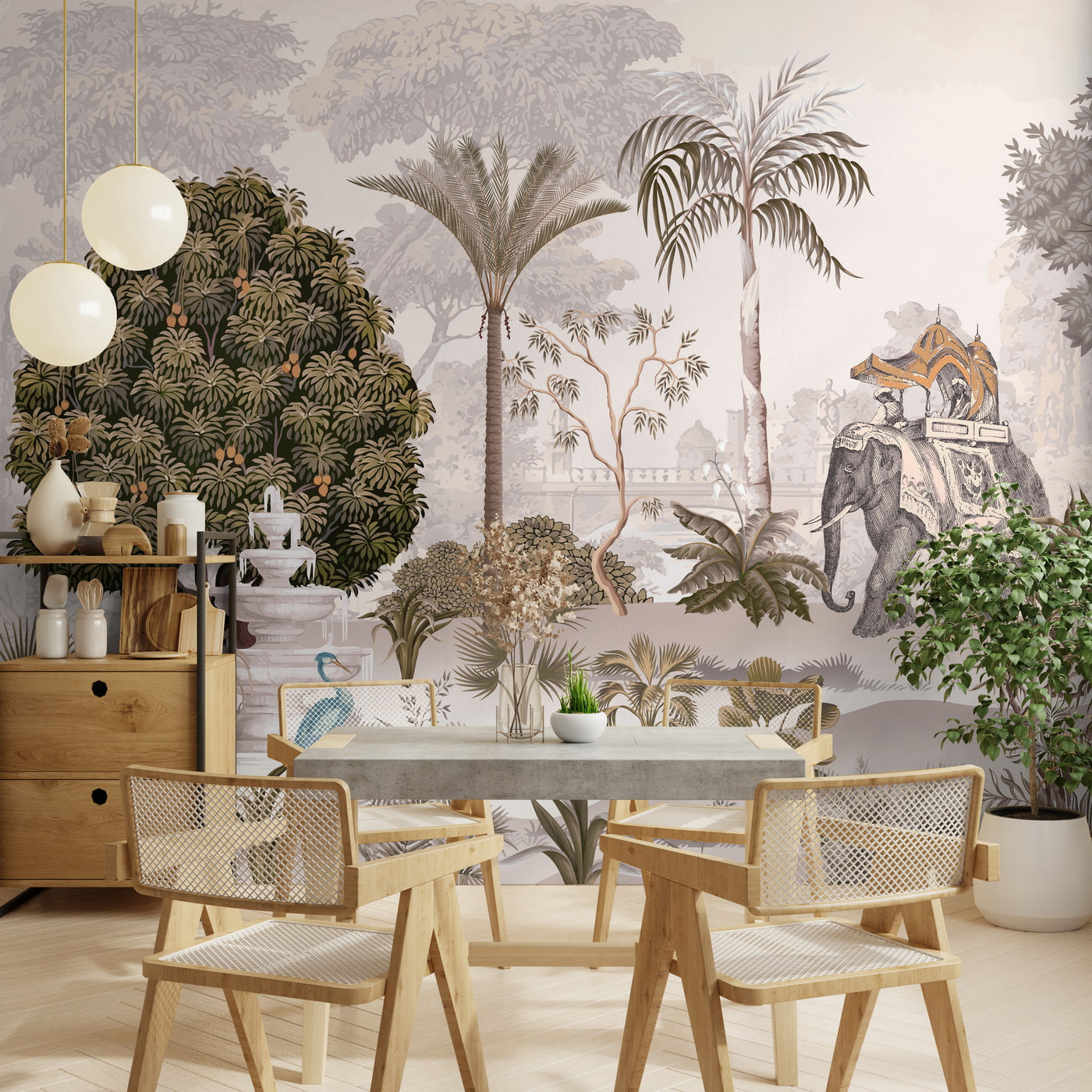
Indian miniature painting offers some of the clearest examples of how forests were visualised. In Rajput and Pahari schools, dense foliage frames human figures without overwhelming them. Trees arch inward, creating enclosure rather than distance. Leaves are patterned, not botanically precise, reinforcing rhythm over realism.
Similarly, temple sculpture frequently integrates vegetal motifs into architecture. Columns grow vines. Friezes are populated with animals emerging from foliage. These elements blur the boundary between built and organic forms, suggesting that human space exists within a larger ecological order.
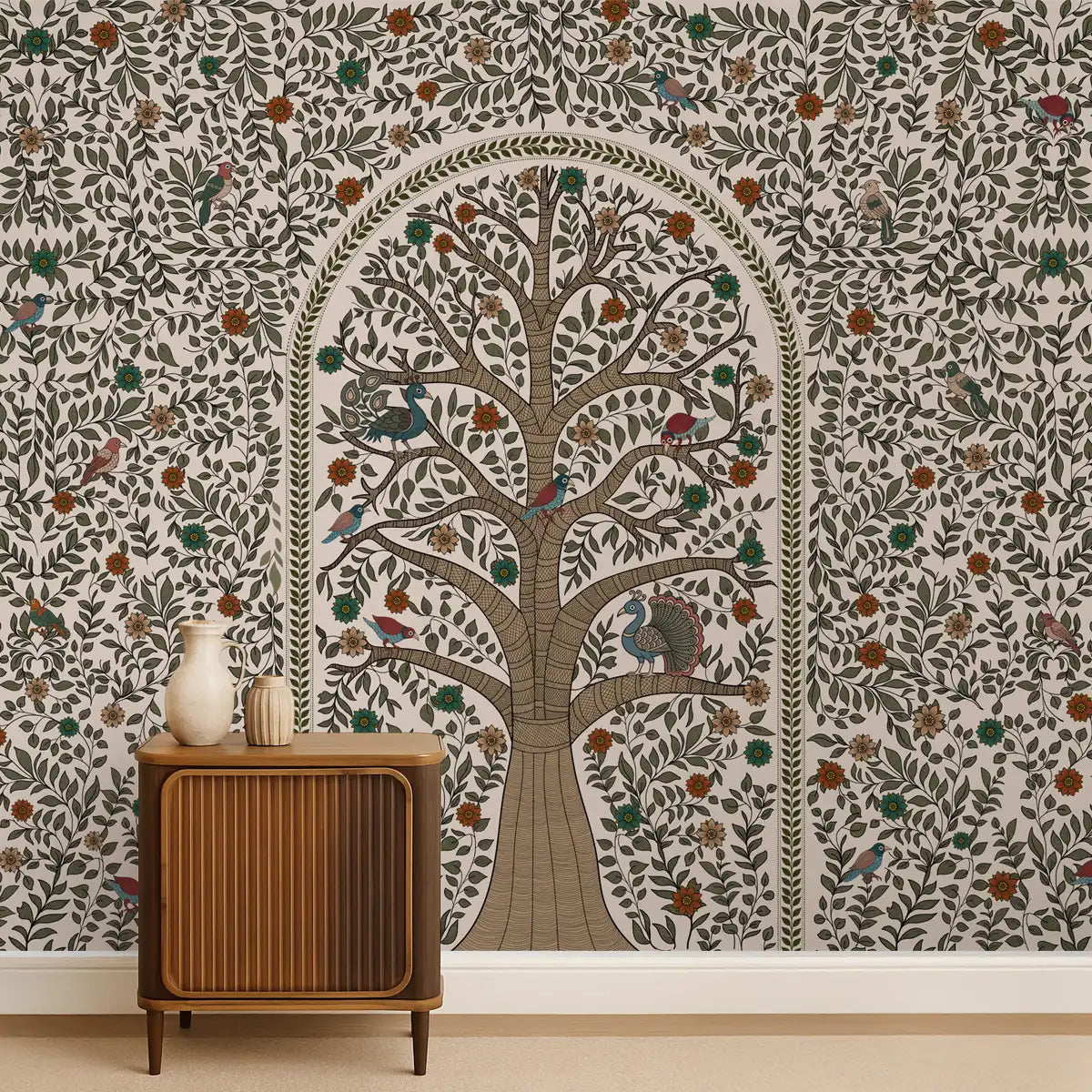
This compositional logic informs contemporary forest wallpaper, where pattern often replaces perspective. Repetition of leaves, trunks, or branches creates immersion without attempting to replicate a literal forest view.
From Manuscript to Interior Surface
Historically, forest imagery appeared on scrolls, murals, textiles, and palace walls. These were communal or ceremonial surfaces, encountered slowly and repeatedly. Wallpaper changes the scale and intimacy of this experience. It brings forest imagery into bedrooms, corridors, and private spaces, where it shapes daily routines rather than ritual moments.
The effectiveness of forest wallpaper lies in its ability to suggest space beyond the wall. Layered canopies, overlapping leaves, and shifting densities create visual depth. Even in small rooms, this can counteract enclosure by introducing a sense of openness.
Unlike landscape murals, forest wallpaper relies on repetition rather than singular scenes. This repetition echoes natural growth patterns, where variation occurs within continuity.
Ecology, Pattern, and Perception
Modern interest in forest imagery coincides with growing ecological awareness. As urban environments become denser, visual references to nature serve both psychological and environmental functions. Research in environmental psychology shows that exposure to natural patterns can reduce stress and improve focus, even when those patterns are representational rather than literal.
Indian forest imagery is particularly effective because it avoids idealisation. Forests are depicted as layered, dense, and alive with interdependence. There is no single focal point. The eye moves continuously, mirroring how one experiences an actual forest.
Applied as forest wallpaper, this quality creates atmosphere rather than narrative. The wall does not tell a story; it sustains a condition.
Why Forest Wallpaper Feels Restorative
The appeal of forest imagery lies partly in its balance between complexity and order. Leaves repeat, but no two are identical. Branches intersect without forming grids. This balance engages the eye without exhausting it.
Indian visual traditions embraced this complexity. Artisans allowed irregularity because nature itself is irregular. In wallpaper design, this translates into patterns that feel organic rather than engineered.
Light plays a crucial role. As daylight shifts, forest patterns appear to move. Shadows deepen under layered foliage. This temporal quality reinforces the sense that the wall is responsive rather than static.
Forest Wallpaper in Contemporary Homes
In modern interiors, forest wallpaper functions best when treated as an environmental element rather than a decorative accent. It can define zones, soften architectural lines, and influence how space is perceived.
In urban homes, forest patterns counterbalance hard materials such as concrete, glass, and steel. In traditional homes, they reinforce existing connections to gardens, courtyards, and verandas.
Because forest imagery carries strong visual presence, restraint matters. Placement, scale, and colour palette determine whether the effect feels immersive or overwhelming.

Designing With Forest Wallpaper
Forest patterns work most effectively when given space to breathe.
-
Use large-scale forest wallpaper in living areas or bedrooms to create visual depth and a sense of openness, especially in rooms with limited natural views.
-
In smaller spaces, choose lighter palettes or more open foliage patterns to maintain balance and avoid visual compression.
-
Let one wall carry the forest while others remain restrained, allowing the eye to rest and the pattern to remain atmospheric rather than dominant.
This approach treats the wall as environment, not backdrop.
Craft and Interpretation
At BRAHM, forest wallpaper designs begin with hand-drawn studies informed by Indian painting traditions and botanical observation. Rather than copying specific species, artists focus on structure: how leaves cluster, how branches overlap, how negative space appears between forms.
These drawings are layered to create depth without relying on photographic realism. Modern printing techniques allow for precision and durability, but the original hand remains visible in line variation and compositional flow.
The aim is translation, not replication. The forest becomes pattern, and pattern becomes atmosphere.
Forests as Cultural Memory
India’s forests have historically been spaces of refuge for communities, artists, and thinkers. They appear in oral traditions, folk songs, and ritual practices across regions. This cultural memory persists even as landscapes change.
When forest wallpaper enters a home, it carries traces of this memory. It does not recreate a specific place, but it recalls a way of relating to space that values coexistence over control.
This is why forest imagery resists trend cycles. Its relevance is not stylistic. It is structural.
Between Nature and Interior
Forest wallpaper occupies a threshold. It is neither outdoors nor fully interior. This ambiguity is its strength. It reminds inhabitants that domestic space does not need to be sealed off from natural rhythms.
Unlike minimalist interiors that strip away reference, forest patterns reintroduce complexity in controlled ways. They acknowledge that comfort can coexist with density, and calm can emerge from richness rather than emptiness.
The Forest, Reconsidered
To live with forest wallpaper is not to escape into nature, but to recognise its continued presence in everyday life. The wall becomes a surface of attention, inviting slower observation.
In Indian visual culture, forests were never silent. They were active, inhabited, and responsive. Wallpaper does not recreate this fully, but it gestures toward it.
What remains is atmosphere: layered, patient, and enduring. The forest returns not as scenery, but as structure, reminding interiors that abundance does not require excess, only balance.
Featured Forest Wallpaper

Nirek Panditha
I was born and raised in Sri Lanka but I come from a half- Indian, half- Sri Lankan background. As I've grown older I've begun to recognise the importance of remembering our collective cultural heritage, be it through the stories, the arts or even craftsmanship that still holds the memory of the hands that shaped it.



Leave a comment
This site is protected by hCaptcha and the hCaptcha Privacy Policy and Terms of Service apply.