











Indian Wallpaper in Modern Homes: From Courtyards to Apartments
Indian design traditions were shaped less by fixed room functions and more by how people moved through space. Homes were organised around circulation, social hierarchy and climate rather than furniture layouts or permanent room labels. This way of thinking about interiors does not disappear when architecture changes. Indian wallpaper in modern homes adapts.
When Indian wallpaper in modern homes is used successfully it is usually because it follows this underlying spatial logic, rather than treating the pattern as surface decoration. The result feels intentional, even contemporary, without relying on imitation or nostalgia.
Spatial Hierarchy Before Decoration with Indian Wallpaper in Modern Homes
Traditional Indian homes did not distribute visual emphasis evenly. Certain spaces carried more visual weight than others depending on their role within the household. Reception areas, transitional spaces and rooms associated with gathering were treated differently from sleeping quarters or service areas.
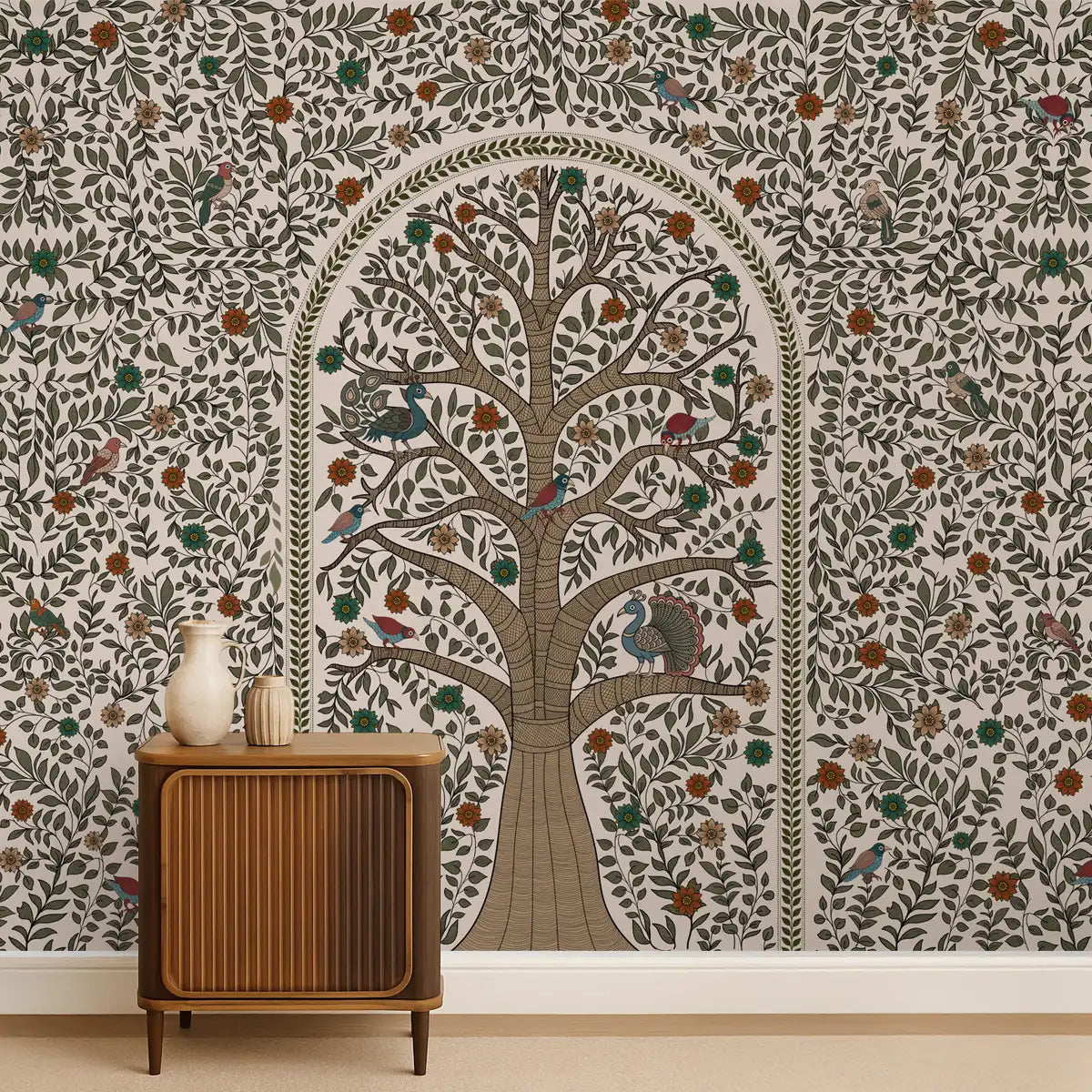
This hierarchy translates well to the use of Indian wallpaper in modern homes. In apartments or suburban homes, wallpaper tends to work best where attention naturally gathers: behind seating, along dining room walls or in entry corridors. When applied to every surface equally, the pattern loses its role as a spatial cue and becomes visual noise.
The key is not restraint for its own sake, but clarity. Indian spatial traditions used surface treatment to signal importance. Indian wallpaper in modern homes can perform the same role today.

Movement Through Space, Not Static Rooms
One defining difference between traditional Indian homes and many contemporary Western ones is the expectation of movement. Rooms were rarely experienced from a single viewpoint. They were entered, crossed, exited and revisited throughout the day.
Patterns were designed with this in mind. Repetition created rhythm rather than focal points. Motifs revealed themselves gradually as one moved through the space.
In modern apartments, this logic applies most clearly to transitional areas: hallways, stair landings, entryways and circulation paths between rooms. Indian wallpaper in modern homes, specifically in these areas aligns naturally with its origins, reinforcing movement rather than demanding stillness.
There is one reason as to why exactly Indian wallpaper often feels more comfortable in corridors than framed art or painted accent walls. It was simply never meant to be experienced from just one angle.

Adapting to Compact Floor Plans
Contemporary apartments compress what older homes distributed. Dining, living, and working often happen within the same room. In these conditions, Indian wallpaper in modern homes becomes a tool for visual organisation.
Rather than dividing space physically, patterns can establish zones. A wallpapered dining wall within a combined living area creates orientation without enclosure. A patterned backdrop behind a work desk signals function without closing off space.
This approach echoes earlier spatial practices, where surfaces helped distinguish use without rigid separation. It also aligns with modern needs for flexibility, allowing rooms to shift purpose without structural change.

Pattern Density and Visual Pace
Not all Indian patterns function the same way. Some rely on dense repetition, others on more open compositions. Historically, these differences often aligned with how long a viewer was expected to remain in a space.
Dense, rhythmic patterns were suited to areas of movement. More expansive compositions appeared where people gathered and stayed. Translating this today using Indian wallpapers in modern homes means considering not just room size, but duration of use.
A small powder room or passage can comfortably hold a dense pattern because time spent there is brief. A bedroom or living area benefits from motifs that allow the eye to rest. This is not a rule, but a way of thinking that prioritises comfort over visual impact.
Light Direction and Orientation
In many modern US homes, light enters from fewer directions than in traditional courtyard houses. Large windows often face a single exposure. This changes how the pattern behaves.
Wallpaper placed opposite a light source tends to read more clearly. Wallpaper placed parallel to windows often appears softer and more textured. Understanding this helps determine placement. A strong motif may work best on a wall that receives indirect light, while subtler patterns can handle direct exposure.
This consideration is practical rather than aesthetic. It reduces glare, improves legibility, and prevents pattern fatigue over time.
Furniture as Spatial Anchor
Modern furniture often carries visual weight through scale rather than ornament. Large sofas, dining tables, and storage units dominate space by mass. Wallpaper interacts with these elements differently than with lighter, traditional furnishings.
When wallpaper is placed behind large furniture, it acts as an anchor rather than a backdrop. This works best when the furniture is visually restrained. When both wall and furniture compete, neither reads clearly.
This balance mirrors older interiors where built-in seating or low furniture allowed walls to carry visual identity. Translating that balance today means choosing where pattern leads and where it supports.
Vertical Emphasis in Apartment Living
Apartments often rely on vertical surfaces to compensate for limited floor area. Walls carry shelving, artwork, lighting, and storage simultaneously. Wallpaper can unify these elements when applied as a continuous surface behind them.
Rather than framing wallpaper as decoration, treating it as part of the wall’s structure allows it to coexist with functional elements. This layered approach reflects long-standing practices where walls held niches, shelves, and surface treatments together.
Cultural Continuity Without Replication
Successful use of Indian wallpaper in contemporary homes does not rely on reproducing traditional interiors. It relies on translating principles: hierarchy, movement, scale, and surface response.
This is why Indian wallpaper often feels at home in modern settings when used thoughtfully. It does not need to explain itself. It simply functions well.
For those exploring this approach, the Indian Wallpaper collection brings together designs chosen for adaptability, patterns that respond to contemporary architecture while remaining grounded in visual traditions.
For readers interested in broader context, our other wallpaper essays explore how specific themes like floral, abstract, animal, forest, and geometric can connect to long-standing design languages.
Shop Indian Wallpaper

Nirek Panditha
I was born and raised in Sri Lanka but I come from a half- Indian, half- Sri Lankan background. As I've grown older I've begun to recognise the importance of remembering our collective cultural heritage, be it through the stories, the arts or even craftsmanship that still holds the memory of the hands that shaped it.


Leave a comment
This site is protected by hCaptcha and the hCaptcha Privacy Policy and Terms of Service apply.